Member of the NEW TRAJECTORIES WEBRING

Monday, July 18, 2022

Sex, Drugs & Magick: Sayyiduna


This is supposedly an American newspaper's depiction on Crowley's Ordo Templi Orientis Abbey of Thelema in Sicily (November 1923)


Sex, Drugs & Magick Chapter Three: The Smoke of the Assassins 


Perhaps I am not subtle enough, but this seems to be the most apropos of all the Wake quotes in this volume. I always found Wilson's anecdote about being excited to see how many times "Leary" and "LSD" appeared in Finnegans Wake until Dr. Leary pointed out that his name was extremely common as lsd is an abbreviation for the pound to be incredibly charming. I love a man who laughs at himself. Perhaps that is why, no matter how I might seem to quibble with the material, I am infinitely grateful Wilson was my guide. Anyways, the quote is so appropriate I feel we must chalk it up to synchronicity or Providence. 


I have talked previously about the legend of Hassan i Sabbah and just how much we need to take with a grain of salt when reading modern accounts of the Old Man of the Mountain. Our culture is awash in the legend, especially within esoteric or counter-cultural circles, the widening gyre of information that is the Internet, even video games and New York Times bestseller book clubs. How much can be believed? I have wrestled, while reading the chapter and composing this post, with that question. I find that I might be too cynical in my view of history, distrusting any reports further back than this morning as untrustworthy. However, whatever truth there might be in Marco Polo's account of Hassan i Sabbah and the Assassins, he most certainly did not bring spaghetti back from China. 


I believe that my distressing skepticism comes partly from reading Michael Muhammad Knight's excellent William S. Burroughs vs. the Quran earlier this year. This book is a captivating memoir that I have mentioned before and I really encourage you to read it. The book contains plenty to interest people with our interests; a discussion of Burroughs' mythologization of Hassan i Sabbah, the career of Peter Lambourn Wilson and even an appearance by the RAW biographer, Prop Anon. While reading the book the weight of Burroughs' influence on Wilson occurred to me as one that I don't think about as much as others; that I should probably attribute much of what Wilson relates about Sabbah as coming from the Burroughs model, which might not be accurate. Wilson himself notes in this chapter that Burroughs held Sabbah in a place of honor, a man who honored so little in the ways of other men.


Indeed, it seems to be a kind of an unintentional game, Westerners trying to figure out who the Hashashin really were and their modus operandi. The Ismaili Muslims of Iran were referred to by other Muslim writers as the "Hashishiyya," but this word was also applied to Sufis or Sufi orders suspected of using hashish. The use of hashish was controversial, then as now, and there was a large amount of prejudice in the Islamic world against those who consumed it. I'll share some Sufi poems that seem to echo sentiments heard in dorm rooms all across our Great Nation:

Hashish contains the meaning of my desire.
You dear people of intelligence and understanding.
They have declared it forbidden without any justification on the basis of reason and tradition. 
Declaring forbidden what is not forbidden is forbidden. 

Preserved or written by Ibn Kathir (14th Century) 

The use of hashish is censured by all silly persons, weak of mind, insensitive,
To the censure coming from stupid and envious individuals.
Share hashish with a goodly young man firm.
In the preservation of friendship and appointments.
Is it not a relaxation for the mind? Thus enjoy
It, all you sensible men!

Muhammad bin Makki bin Ali bin al-Hussain al-Mashhadi (11th Century?) 

However, lest we get the idea that medieval Sufis were proto-hippies, they were (and are) a diverse group of peoples; the same source where I found the above poems also includes a Sufi poet condemning the use of hashish. It also seems that, far from the more colorful legend of converting the fidai, that the original belief in the Western popular imagination about the Ismailis and linking them to hashish was the belief that the fidai used hashish before battle/assassinations to give them courage. (An interesting idea for anyone who has gotten too high and tried to go grocery shopping, which quickly becomes a visit to Tartarus.) As far as I could tell, there are many historians who have concluded that Hassan i Sabbah was nothing more than a very pious Shia Muslim. But that just isn't as much fun, is it? 

Wilson says: "Hassan made modernists and even post-modernists out of his contemporaries, and they didn't like it at all." Perhaps Hassan taught us all, even if unintentionally, a centuries-early lesson in post-modernism. And if we are to be post-modern, then we can choose whatever historical quasi-fiction we wish to believe. So, if we desire a fitting narrative for Sayidunna, we need to go no further than the beginning of the twentieth century in the Balkans. In a novel called Alamut, the Slovenian writer Vladimir Bartol laid the groundwork for the modern take on Hassan i Sabbah. The novel concerns the initiation of ibn Tahir into the ranks of the fedayin as well as the recruitment of some of the "houris" to inhabit his faux-paradise. A psychological novel, Alamut concerns itself with the brainwashed devotees and the discovery of Hassan's ruse on the part of one "houri" and ibn Tahir. The novel concludes with ibn Tahir confronting Hassan where the Old Man utters his motto to him, not to Burzug Umid. Alamut also contains the incident recounted at the end of this chapter, however it is Hassan who orders two fedayin to take their lives instead of Sinan. While it might not be perfectly accurate, it is a good yarn and the speech Hassan gives to ibn Tahir concerning the watchers atop A'raf has haunted me the years since reading it. 

(And at this point I'd like to report that in Philip Farber's excellent High Magick: A Guide to Cannabis in Ritual and Mysticism, it is noted that, similar to the Hindu soma, the Zoroastrians had the drug haoma. Like soma, haoma has been conjectured as originally indicating many different drugs; yet, based on various descriptions it seem highly likely that the plant indicated by these terms was cannabis. (A far more pleasant, common intoxicant in that area of the world than amanita muscaria.) Farber notes that while some Zoroastrians and historians write about Zoroaster condemning the use of haoma, it was another drug he condemned in the Avesta, mada, which might have been the same as haoma, but might not have been. (Fun, right? Why can't people read religious texts clearly?) The modern haoma ritual of Zoroastrianism uses ephedra or Syrian rue for the substance, but Farber contends that the original psychoactive haoma was kept for the "magi" priest-class of Zoroastrians. All of this is for me to say that Zoroastrians are originally from the same Persian area that the Ismailis would inhabit.) 

Further into the chapter, closer to us than Hassan i Sabbah but prey to as much, if not more, obfuscation and confusion is the discussion of Crowleyean sex magick. This chapter is incredibly important because here, in plain enough text, Wilson reveals the operation of sex magick and provides enough information to piece together the Ninth Degree Ritual of the Ordo Templi Orientis, its most prized secret. It was from this chapter that I was able to piece together the operation in whole; when I told one teacher I believed that I had divined "a part" of the ritual, he simply replied "a part?" 

Based on my further research, my conclusion was correct. While it is dressed up in his charmingly ridiculous bombast, Louis T. Culling's Sex Magick and The Complete Magickal Curriculum of the Secret Order G.B.G. also provide the essential part of the operation as well as including "Of The Homunculus" (a secret instruction of the Ninth Degree) in his writing about "the bud-will." Granted, this is tied up in C.F. Russell's/Culling's rigmarole, but all of that is quite entertaining in and of itself. (God, I love Culling.) Much of my confirmation comes from Francis King's The Secret Rituals of the O.T.O. and various back papers in his Crowley On Christ. I should note that Caliphate partisans are happy to say that King's book, aside from being illegally printed in the first place, is devastatingly flawed. Aside from mumblings about the Third Degree Ritual, I have never been given a satisfactory explanation of how it is in any way incorrect that didn't smack of misdirecting insincerity along with unfamiliarity with the text. King himself states that his work was based on the collection of Frater Volo Intelligere, Gerald Yorke, who was as in-the-know as any of Crowley's acquaintances, even if he wasn't a member of the O.T.O.. Crowley's opus, Magick Book 4, is dedicated in part to Frater Volo Intelligere. 

Aside from spilling the beans in this manner, Wilson also reveals, as he does for us in other works, what he believes to be the incriminating poem in Crowley's The Book of Lies. Chapter 69 goes as follows: 

THE WAY TO SUCCEED -- AND THE WAY TO SUCK EGGS!

This is the Holy Hexagram.
Plunge from the height, O God, and interlock with
    Man!
Plunge from the height, O Man, and interlock with
    Beast!
The Red Triangle is the descending tongue of grace;
    the Blue Triangle is the ascending tongue of
    prayer.
This Interchange, the Double Gift of Tongues, the
    Word of Double Power -- ABRAHADABRA! -- is
    the sign of the GREAT WORK, for the GREAT WORK is accomplished in Silence. And behold, is
    not that Word equal to Cheth, that is Cancer, whose Sigil is 69*?
This Work also eats up itself, accomplishes its own
    end, nourishes the worker, leaves no seed, is perfect in itself.
Little children, love one another!

[*In the poem proper, the "69" is the astrological sign of Cancer.] 

A poem that isn't a poem and isn't usually included in the running for the poem that put Reuss in a mood but shares similar concerns is #36 which contains the original version of Crowley's version of the Lesser Ritual of the Hexagram, The Star Sapphire. I can personally attest that regular practice of this ritual is transformative and comforting in many ways, especially when coupled with the theory expressed in #69. Wilson says of this: "I learned this [that Crowley could appreciate the inner meaning of mystical Christianity] directly by performing his Lesser Ritual of the Hexagram (a combination of Christian and Egyptian invocations, and one of the most powerful consciousness-altering techniques I know), which gave me an entirely new and fresh insight into the central Christian symbolism of Crucifixion and Resurrection." If you're looking for something to do, I think Wilson would echo my recommendation to commit the Star Sapphire to heart. 

Let's move away from the mysterious men and their shroud of smoke for now, though they may already have captured our imaginations. 

Stray Thoughts

- Wilson quotes Crowley's "The Psychology of Hashish," which was originally attributed to Oliver Haddo, the decidedly unflattering portrait of Crowley offered in Somerset Maugham's The Magician. "The Psychology of Hashish" is the second, and by far the most valuable/instructive part of Crowley's compendium of marijuaniana The Herb Dangerous. The other three portions of Crowley's study are composed of a dry medical report by a (seemingly real not-actually-Crowley-persona) English physician on cannabis: the other two sections are a translation of a poem on hashish by Baudelaire and an excerpt from "The Hasheesh Eater" by Fritz Hugh Ludlow. Regardie, in his introduction to The Herb Dangerous in the Sixties reprint Roll Away the Stone, compares Ludlow's work to de Quincey's and presciently calls for a reprint that would surely be (and proved) popular with the then-current generation. 

- Speaking of Baudelaire, it should be said that his and Gautier's descriptions of the effects of hashish are best taken as reports from Olympus. They are an example of what I like to call "the absinthe problem." I had always heard that absinthe was hallucinogenic because of the presence of wormwood in the 19th century recipe, which has been removed in our modern productions. However, I had also read in accounts that the wormwood's presence was negligible and that the riotous effects upon the imagination are in themselves imaginary and to be attributed to nothing more than absinthe's not-insubstantial alcohol content and romance. (I really should read Phil Baker's history of absinthe.) Both reading Baudelaire's Les Fleurs du Mal and Gautier's Mademoiselle de Maupin can prove without doubt that each of them is capable of intoxicating the reader with nothing more than words, it goes to follow that the effects of any drug would loosen their already-tenuous grip on this dull world. I believe Wilson will later discuss how disappointed that many a hippie was to discover that opium doesn't deliver the reveries of "Kubla Khan" or The Opium-eater's visions. Alas, we are not all naturally gifted with the fervid imagination of Coleridge or de Quincey. 

- I could find nothing about Ismaili fedai wielding a flame dagger, celebrated or otherwise. 

- In High Magick, Philip Farber also writes about the ancient notations of the perhaps-mythical Shen Neng/Shennong on cannabis. Farber interestingly relates that Shennong also stated, aside from extolling the medical benefits of cannabis, that "[c]annabis...enabled seekers to forget their own consciousness and attain the Tao." Farber also notes that while cannabis was not looked kindly upon by Confucianists, some parts of Taoism have always retained a fondness for the drug and that one of the eight Taoist immortals is Ma Gu...which translates as "Hemp Maiden" or, delightfully, "Auntie Hemp." 

- I looked up Dr. Michael Aldritch, something I don't think I've ever done before this reading. I couldn't find much about him, but he is still around and evidently wrote the now-uncommon Drugs-For & Against. He also contributed to the "High Times" Encyclopedia of Recreational Drugs

- I am disappointed that after multiple rereadings of this text, I still haven't read Terry Southern's "The Blood of a Wig." The story, found in Red Dirt Marijuana and Other Tales, concerns the account of a magazine editor's outrageous drug use. Evidently the titles refer to injecting the blood of a schizophrenia patient (the "wig") and contains this bit about the Kennedy assassination: 

- I learned, through trial and major error, that it is never in one's best interest to bring up the feeding of the Red Lion or the White Eagle in their truest sense, save when under the rose. 


Thursday, July 7, 2022

Sex, Drugs & Magick: Illusionogenic

Still from I Love You, Alice B. Toklas! (1968)

 Sex, Drugs and Magick Interlude: Divorce Psychedelic Style: The Story of Tom & Jerri

Reading this was a reminder of how far we are from the Sixties, which in many ways laid the foundations of today's world, for better or worse. We get to walk down memory lane when Dorothy Day was still influential, there were Fidelistos in the United States and even witness the appearance of an automat. Occasionally you'll see a Dorothy Day quote pop up anymore, but leftist Catholics aren't really something you run into everyday in our brave century. While Che Guevara posters/t-shirts were popular during my youth in the late nineties-early aughts, I doubt even those who knew who Che Guevara was would have said they supported Fidel Castro. And I don't even know if there's an automat left on the face of the earth today. Tom and Jerri's story, more than those of Jane or Leonard, is a story of the progression of the Sixties. 

Like Jane and Leonard, Wilson shows occasional glimpses of contempt for his subjects. He doesn't admire their hardline Marxism/Christian radicalism when he meets them and obviously thought that Tom's hardline approach was detrimental to his children. (Like many children of the movers and shakers of that era, I wonder how Tom and Jerri's kids felt about their childhood, spent in unique living situations due to their parents (over?) abundance of belief.)  As the chapter approaches the end of Tom's progression towards his "Church of One Flesh," Wilson seems to be raising his eyebrows in bemusement and even includes the incestuous aspect of Tom's acid-enlightenment for the reader to balk or gawk at. 

The message from this story seems to be the same as Leonard's, to a different degree- be careful where these chemicals take you. Wilson doesn't object to the use of drugs, and he scrupulously doesn't object to anything directly or to the subjects of the stories during his appearances, but rather seems to be fascinated by how the drugs can "take over" unsuspecting or overly-credulous users. Unlike the end of Leonard's story, neither Tom nor Jerri seem to end up in truly pathetic states at the end of the chapter. Unless you're invested in Tom and Jerri's marriage, which would be an odd choice considering how lackluster their relationship seems to have been, nothing too horrible happens to either. Things "end" a bit bizarrely on Tom's part, but at least he was still visiting his kids. 

One things that this interlude contains, and which I feel I should contest, is Wilson's assertion that users cannot take acid more than once a week. Perhaps this was a deliberate blind on Wilson's part, on the naivety of a Wilson who hadn't quite subjected himself to his truly bracing experiences with Hoffman's problem child, but I believe either way the information is simply wrong. 

Three bits against Wilson's pronouncement. First, in my personal experience I have tripped multiple times within the span of a few days. This is the easiest piece of evidence to refute as one could assert that because of the day and age we live in, I can't be sure I received true LSD-25. Secondly, Wilson himself later reveals (This is in Cosmic Trigger II, I believe. Tom, can you confirm?) that he censored the truth in the later Cosmic Trigger about his use of acid and seems to have been using it very frequently during that time period. Thirdly, John Higgs' revolutionarily awe-some biography of Timothy Leary, I Have America Surrounded, scrupulously recounts Leary's use of acid which was certainly on a daily basis for many parts of his life. 

So what is the explanation? It certainly could have been a deliberate lie as Wilson does seem concerned with what acid can do to the unprepared. We know that the Wilson who wrote Cosmic Trigger seemed concerned that admitting to his own acid-consumption could strip him of credibility. Or was Wilson simply not yet inducted into the frequent use of LSD when he published Sex, Drugs and Magick? I'm genuinely curious as to what the reader thinks about this. 

Stray Thoughts

- An amusing part of this chapter is where the Wilson of the Interlude seems to be "weirded out" (peculiared out?) by the acidhead copywriter who claims he was in contact with flying saucers as we all know that Wilson would shortly be experiencing his own extraterrestrial, acid-aided communication with beings from Sirius. 

- Wilson also provides us with two explanations for why LSD users adopt counter cultural ideas; is it the milieu of people that use and have access to acid or is it the alienating effect of lysergic acid? This is another bit where I'd be interested in hearing what the reader of this post thinks. For me, I imagine that both theories have some truth to them. I can't say that my psychedelic experiments made me into a crunchy hippie, but I do share many qualities with the counter culture and I know that those substances changed or clarified me. 

- Tom's network of sexual partners is laughable to me as I have personally witnessed the incredible animosity that people can have towards a partner or former partner's current or former lovers. (I feel like there is a comma missing in that sentence.) Sex and violence are closely linked in the human mind, I've never bought into the Free Love Movement's ideas that it is a pure expression of community. 

- Maybe don't "ball" your sister? 


Wednesday, June 29, 2022

Sex, Drugs & Magick Chapter Two: Don't Bother


Detail from Botticelli's Venus and Mars: is the satyr grasping datura stramonium? 

Sex, Drugs & Magick Chapter Two: Horned Gods and Horny Potions

I think my title for this week is much more accurate than the actual title of the chapter; everything I've read about solanaceous drugs comes to the same conclusion- they're not worth the hassle. (I guess it could be argued that the factitious works of Castaneda portray jimson weed in a positive light in the first couple books, though I'd argue that the tone of those works is still cautionary and highly, if perhaps falsely, contextualized.) Wilson later wrote : "[t]he four weirdest and scariest drug stories I know all involve belladonna, a chemical for which I now have the same sincere respect as I have for hungry tigers, earthquakes, floods, wildfires, the IRS and Dr. Hannibal Lecter." In his short essay "La Belle Dame Sans Merci," that introduction is followed by a harrowing account of a very unpleasant trip though separate realities that Wilson experienced while living in Yellow Springs with Arlen (who briefly, through Wilson's solanaceous lenses turned into a vampire). 

In Jim DeKorne's excellent Psychedelic Shamanism the solanaceous drugs are discussed as "belladonna alkaloids" and he focuses mostly on the use of different strains of datura grown in North America, colloquially referred to as jimson weed or thorn apple. DeKorne attributes the popularity (?) of experimentation with belladonna alkaloids to the aforementioned works of Carlos Castaneda and makes some fascinating observations about the usage of this family of drugs. To DeKorne, datura is a distinctly feminine drug, something that can be backed up by Don Juan's imaginary expertise, and is known for its dangerous twists and turns; he equates datura, quite poetically, with the femme fatale stereotype. DeKorne notes that trips utilizing belladonna alkaloids often are bad trips in the context of male, Western users but serve a beneficial, or at least non-traumatizing, purpose for female and indigenous users throughout history. DeKorne also brings up the modern hypothesis that the broomstick is associated with witchcraft because medieval witches perhaps applied their "flying ointment" to their genitals using broom handles as the applicator/dildo. I would imagine that this idea would not have been in the milieu at the time Wilson wrote Sex, Drugs & Magick, or he surely would have included it in this tome. 

Whatever the case, DeKorne concludes that with other, less dangerous and more predictable doorways to eternity available, it is best to avoid consuming belladonna alkaloids. He does recommend growing datura, which when I read the book I took to heart and for one summer/autumn I had two large datura plants, they grow quickly, in my apartment's backyard. I only had one a handful of blossoms appear, the blossoms are quite beautiful and give datura another one of its names: "angel's trumpet." I also found the plants to be distinctly feminine, probably because of DeKorne's impressions on me and their association with witchcraft. I cannot say that I ever tried datura or any other derivative from this family, my wiser teachers got to me early and by the time I read Castaneda, I knew to take everything with a grain of salt. 

Historically, there's a lot to talk about concerning the solanaceous drugs, but practically it seems like there is very little use for them. (I do raise my eyebrow at the suggestion that Euripides' maenads are obviously under the influence of solanaceous drugs.) Perhaps it is best to view this family of drugs as the exclusive purview of indigenous populations who have retained a contextual practice for utilizing them and as an art that has been lost in our Western culture, burned away with what few practitioners may or may not have been persecuted during the days of witch hunts. All reconstructed recipes of "flying ointment" I have ever seen come with strict warnings that these are conjectural and for intellectual purposes only. 

Stray Thoughts

- The Book of Shadows that Wilson references certainly isn't centuries old; Wicca was made up whole cloth by Gerald Gardner in the mid-twentieth century. (Wilson does include Francis King's similar assessment.) While this doesn't delegitimize the religion, the constant aping at an obviously made-up sense of posterity is embarrassing. Like most things in modern magic, the elements of Wicca can be traced back to Aleister Crowley. Crowley, in his old age, had some remaining fans/disciples/hanger-ons including Gerald Yorke, Kenneth Grant and Gerald Gardner. Crowley was the co-author of the three Degree rites of Gardnerian Wicca or Gardner was heavily influenced by Crowley's writing when he authored the rites himself. This Crowleyean influence would diminish as Gardner's Wicca philosophy matured. 

- In his essay "Magic, Running Through the Gutters Like Lightning," Alan Moore references the idea of flying ointment and the broomstick applicator and advises the reader: "best not to think of the Quidditch changing rooms in Harry Potter." Speaking of Harry Potter, I wonder what Wilson, who predicted that Dr. Strangelove may contain the last major reference to mandrakes, would think of today's world where plush and animatronic mandrakes are available in bookstores because of The Boy Who Was Worth Millions. 

- "La Belle Dame Sans Merci" was published in email to the Universe, available from Hilaritas Press

- Here is an article that discusses the Botticelli painting that serves as the illustration for this week. The article describes datura as "poor man's acid" and have an effect that is "half alcohol and half opium," I would say our other sources disagree. 

- I read John Dickson Carr's The Crooked Hinge some years ago on Wilson's recommendation in this chapter. I remember being slightly disappointed by what I perceived as too little drugged witchcraft but the denouement is as interesting as our author suggests. It also involves the Titanic! 


Tuesday, June 21, 2022

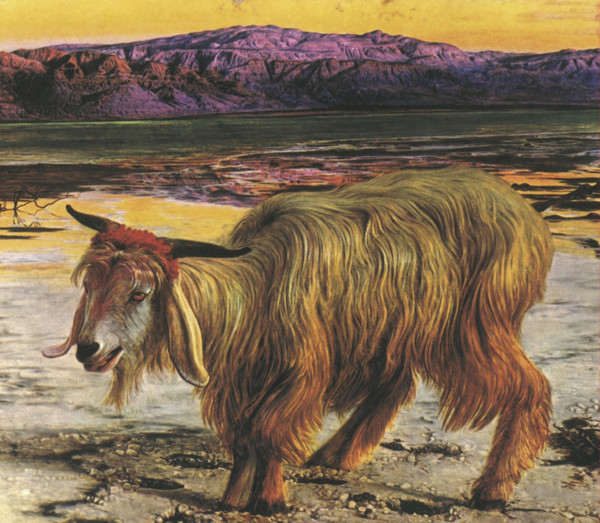
Sex, Drugs & Magick: while the worst are full of passionate intensity


The Scapegoat by William Holman Hunt

Sex, Drugs & Magick: Slouching Towards Bethlehem: The Story of Leonard 

Is there any way to read the Story of Leonard as anything more than a warning? Perhaps we can look at it as a funny anecdote, but that seems cruel- so a warning it must be, since Wilson doesn't paint a very positive picture of "Leonard." 

From the beginning of the chapter, where Leonard asks to masturbate in front of the others, the average reader would be inclined to see this person as an extreme abnormality. Even if Wilson wasn't personally offended by the request, he surely would have known that even his open-minded readership would, for the most part, find this to be a shocking incident. Wilson, who was obviously uncomfortable with the request, is more even-handed in his actions than most people would be. Perhaps, in Wilson's mind, this is meant to be a psychological profile, similar to the story of Jane, but it is far removed from the clinical setting. Thus it becomes something of a curiosity, a grim invitation to see where being too malleable and adaptable to new ideas and phases can lead. 

I knew a couple of people who resembled Leonard greatly in my youth. Around the time I first read the story I was immediate reminded of a pair of particular acquaintances. Both were bright, for as Wilson points out "dimwits do not acquire such remarkable notions," but I didn't think too highly of either of them. Both came from a fundamentalist/evangelical background which they divorced from more-or-less violently during the blossoming of late adolescence. One went on to obsessively follow atheism and then Ayn Rand libertarianism, came out as gay, had a brief dalliance with drug-inspired spirituality, became a drag enthusiast and then a punk anarchist (still can't quite wrap my head around what that even was) and last I heard had settled into a new type of religion: the insufferable modern academic. The other was the more irritatingly Christian of the two, who went to NYC, became a fashion model, came out as gay, became a cocaine and nightlife enthusiast and last I heard was back home, an enthusiastic fundamentalist lay-preacher who publicly renounced his "evil" ways. It is truly bizarre where life leads you when you become an operative of ideas instead of making ideas work for you. 

In college I witnessed many friends try psychedelics or marijuana for the first time and experience periods of LSD-evangelism or spiritual dabbling that faded as quickly as it came on. By the time I tried LSD, I was so fully influenced by watching others that the trip wasn't particularly revolutionary- I was painfully aware that all of the "revelations," while fun in the moment, would fade when faced with the harsh light of day(s). Indeed, one of my favorite parts of Mad Men is Roger Sterling's brief acid enlightenment that is referenced a few episodes later when he has resumed his capitalist, shallow ways: "I guess it wore off." This isn't to say that my LSD experiences weren't enjoyable or had no effect, but by that time in my life, filled with the history of acid's ups and downs, the glamour wasn't quite as convincing. 

I can think of a few reasons I didn't go down a similar path: my endemic cynicism makes me resistant to groupthink or finding other people's lifestyles enviable, I have kept a few obsessive interests which align outside experiences firmly within my lenses, and I was deathly afraid of ever appearing foolish or impressionable. (And unlike the two aforementioned "Leonard-types," while I was raised in a Christian family, they weren't fundamentalists.) These tendencies have their downsides as well, but I personally consider avoiding fundamentalist Christianity and public masturbation as wins. I don't think much of dabblers and am somewhat of the belief that a too-open mind lets in a lot of trash. Our intellectual discrimination is a valuable, essential tool in navigating the forests (and weeds) of ideas we encounter in life. 

Stray Thoughts

  • It is somewhat obvious that Leonard, or at least Sandra, were students at Antioch while Bob and Arlen lived in Yellow Springs, OH. Wilson was fond of writing about how Antioch was filled with strange, ahead of the curve ideas in other pieces; I imagine that Leonard/Sandra were part of his inspiration for that belief. Concerning Sandra, I think it is interesting how contemptuously Wilson describes her- if anything, the brief sentences given to her are perhaps more unflattering than the entire portrait of her wayward beau. 
  • Another bit of history in this chapter is how Wilson describes himself as following a radical right-wing libertarian philosophy. This notion of a superior "right-wing" libertarianism is presented in Illuminatus in the form of Hagbard Celine and his crew of merry submariners. A reader could notice that Wilson does not describe himself as "right-wing" in his writings from the eighties onward. (This isn't to say that Wilson ever paid lip-service to being left-wing.) One can imagine (presume?) that the rise of the Moral Majority and the Reagan Revolution made the notion of being a right-wing anything distasteful to Wilson. 

Keep your head on your shoulders, not between your legs. Enjoy the scenery, but don't become a part of it. 


Sunday, June 12, 2022

Sex, Drugs & Magick Chapter One: We shall win Jackie is an ego bitch Farewell

Taken from the Kerista Commune website

Sex, Drugs & Magick: Chapter One: Overview The Brews of Aphrodite

Wilson starts us off with a comprehensive overview of the subject matter of the book using a familiar cast of backing sources. Much of the information is outdated or wasn't accurate at the time; but the gist of his argument remains strong. Indeed, we can see the seeds of the philosophy behind today's (often misrepresented and unfairly maligned) harm-reduction policies in this chapter in his arguments that people aren't going to stop using drugs and therefore accurate information and safety measures should be put in place. On the other hand, as utterly charming as the Burroughs version of Hassan-i-Sabbah and the Hashashin might be, we know that it is fantastical, to say the least. Given the benefits of hindsight, modern readers can clearly see Leary's showman shift while talking about sex and acid to Playboy magazine...we are in waters that are still muddled by decades of red tape and corpses piled up from the ever-raging Culture War. 

Nevertheless, we are in good hands as Wilson's specialty is navigating the muddle and he takes an appropriately skeptical position while relating the arguments. He builds up to this at the end when he sets up the idea that he can only present the information he has been given. Wilson cannily uses a mixture of research, sourced-ideas and personal anecdotes throughout the book, providing the audience with something more than a single research paper, prepared with amateurish enthusiasm. (I do not use the term amateur as a slight or as a belittling word choice, but rather in the true sense of the word.) 

During his foundational chapter, Wilson also begins his tour of odd peoples and ideas which proliferated in the latter half of twentieth century America. The Kerista cult is a suitably fascinating group that he passes over and has led me to research the group multiple times when reading this book. This time around I found that there is now a documentary on the group which I'll have to watch titled Far Out West. (Interestingly Kerista's free love commune introduced the word "compersion" into the lexicon. Compersion is the supposed feeling of fear/pleasure that comes with sharing your intimate partner's affections.) Kerry Thornley was a member of the San Francisco Kerista commune and it is likely much of what Wilson knew about the group came from him, along with "Tree," as it were. Kerista was heavily inspired by Robert Heinlein's Stranger in a Strange land and interestingly, one of the "acid-cults" that Wilson chooses not to name for their privacy clearly seems to be the Church of All Worlds, which Margot Adler would later write about in Drawing Down the Moon

If one pays enough attention we can see that the article in Time magazine that Wilson cites as saying that Gnosticism is the most important idea in the modern world must be discussing the work of Voegelin's which introduces the phrase "immanentize the eschaton," made famous in Illuminatus!. It appears that the article might have been penned by that King of the Squares, William F. Buckley Jr.. The article appears in the larger context of Wilson's argument that the War on Drugs can be seen as an extension of the religious wars that have plagued mankind since Rome. It is a frustrating argument because it is convincing. Wilson also relates some sober history lessons about our country's founders views on religion that more Americans need to read today. Desperately. 

Next Up is the Story of Leonard, which I have already mentioned slightly horrified me every reread. I'll see if I can come up with something useful to say. As a editorial note: we are back to our regular broadcast schedule this week as I am finally free for the summer. It was a sprint to the finish line the last few months and it is a relief to be able to focus on my personal projects now. 

Monday, May 2, 2022

Sex, Drugs & Magick: Beethoven Himself Turning Into A Gigantic Female Bull

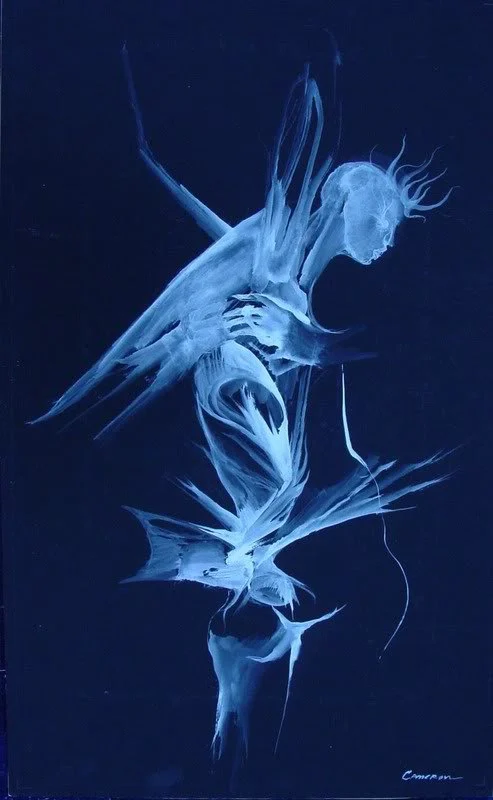
Fossil Angel- Cameron

Sex, Drugs & Magick: Prelude, Ice Maiden: The Story of Jane 
or, You Know She's A Drag By The Jive Things She's Done

I'm not sure I feel comfortable writing about frigidity. I am familiar with the concept, but I am unsure that it is or was anything more than a result of the psychological war our society wages against female sexuality. It is significant to me that "Jane's" story closes with her writing for magazines aligned with the nascent Women's Liberation movement. 

...I think it has been almost two weeks since I wrote the previous paragraph. I apologize. My profession has a the delightful (irritating) proviso that one must continue their education (waste time you don't have) to keep you license. I just finished a gauntlet of "streamlined" classes that left little time left for anything aside from light reading and being with my family in the evenings. I am now able to breathe a bit and I am back. In class, we just finished our Higgs-centric unit and I suggest checking out his latest newsletter that seemed like a fitting coda for my qualms, this time around. 

Two weeks does give one time to think, even when there isn't much time to think and I thought to ask my lovely wife, who is conveniently female, a historian and a therapist, about her ideas about so-called "frigidity." This is an approximation of our conversation: 

Frigidity surprisingly does exist as a diagnosis anymore, but under a different name in the DSM-V; it is now deemed "female sexual interest/desire disorder." Hilariously, this and its male counterpart "male hypoactive sexual desire disorder" (interesting that terms are different, no?) include what we would today call asexuality and cheating on a partner. I wondered if frigidity could have been caused by underdiagnoses of endometriosis, pelvic inflammation or other conditions that cause sex to be painful. That ended with a "maybe" and a discussion of vaginismus. I have been under the impression that vaginismus mostly occurs in religious communities and it seems that the data would back that impression up. Therefore I'd wage a lot of "frigid" women were merely warped by their repressive, nigh-criminal upbringings. 

I wanted to ask about anorgasmia which I was interested in for two reasons: one) I had a hunch that it didn't truly exist and two) I share Wilson's impression of parties who haven't had an orgasm as having been unlucky in the lover lottery. (Can you imagine the amount of men that were knowledgeable about women's pleasure in the fifties/sixties?) It seems that, cases of nerve damage and medication excepted, anorgasmia is almost entirely due to what are, in my opinion, easily identifiable psychological traumas. I'm not saying that periods of decreased sexual interest or decreased orgasms are a reason to rush to the doctor, but if they should persist (for more than four hours) one should probably consider checking in with a professional. 

But Jane didn't have that option, given that she was a woman in the mid-twentieth century. How many competent doctors could there have been at the time; one should remember this was shortly after the fad of living room lobotomies for depressed housewives. 

One of the greatest charms of these semi-fictionalized mini-biographies is that we get glimpses into a younger Wilson's life and thoughts. As I have contemplated Wilson's life in relation to my own many times, however drastically dissimilar they were/are, I can't help but see some reflections in the story. When I was younger, I met a waitress where I worked who was addicted to heroin. Because I was visibly hippieish at the time, she believed I had access to LSD. I didn't and hadn't tried "Leary's panacea" at that point. She desperately wanted to try acid as she believed it would be the trigger to cure her addiction. I don't remember ever hearing if she ever found LSD, so I don't know the results of her experience. I've known a few people whose lives were revolutionize the first time they tried Hoffman's problem child, but it never seemed to last. It would wear off surprisingly quickly after a couple weeks of elation and revelation...a few times I can remember it led to much more bitter worldviews than that of the pre-trip personality. I also don't think the profound physiological addiction of heroin works that way. I do hope she found some safety and peace. 

The first couple time I read this book, I took these anecdotes as solemn warnings where almost every character seemed like a pathetic nut who ends up worse than they were before. I'm not sure I see Jane's story as something like that now; instead, it seems to be an account of a human dealing with life in the way that many humans do that has a happy-enough ending. Jane was born into a world that was hostile towards her in many ways and rose to prominence in a field so misogynistic, they made an award-winning show about it. No wonder she was all bothered without being able to get hot. Good for her for jumping in on the future, even if she didn't get paid. Perhaps the sixties were the last time money truly didn't have to matter. I will say this, my wife got the final word on the tale: "maybe don't fuck a teenager, though." 


Saturday, April 2, 2022

Sex, Drugs & Magick: That Paleolithic Sentiment

As an attempt at apology for my absence, I'm going to cover both the Preface to the 1987 Edition as well as the original introduction to keep the group moving ahead apace.


The possibly suppressed first edition.

Sex, Drugs and Magick: Preface to the 1987 Edition

While not as humorous as the Preface to the 2000 Edition, Wilson's 1987 Preface is a valuable addition to the text. As it seems that the New Falcon edition of the text was the first that would be widely available, Wilson adds some much needed context to the book and reveals the secrets of its composition that he was unable to in 1972 when it was published under the title Sex and Drugs: A Journey Beyond Limits.

The anecdote about what Hefner supposedly said about Wilson's original title for the book, Sex, Drugs & the Occult, has always managed to elicit a chuckle and is one of the main things I think about when I think about Hefner. That and the scene from The Sex Magicians where the Hugh Hefner stand-in receives a blowjob while conferencing with one of his editors about how much he hates Spiro Agnew. As Wilson notes, the real Hugh Hefner was hard to pin down, as he was hidden behind an aura of the sophisticated lothario who shielded himself at the heart of his media empire. Over the years Hefner became a figure who reaped laughing accolades for maintaining his libidinous lifestyle until the end of his nonagenarian life. In the information-rich dissipative structure of the year 2022 E.V., a new docuseries supposedly reveals more salacious details about the publisher, including allegations of rape and bestiality. The myth continues to spawn questions, and now that the man is five years dead, it is unlikely we'll ever get to know much about the "real" Hugh Hefner. He is now firmly in the company of the imaginary rabbits listed by Wilson, although he casts a distinctly more sinister shadow.

Wilson's Greater Feast proceeded his former employer's by a decade and Wilson seems to have never met with Hef in the flesh, so less can be revealed about the potential suppression of Sex and Drugs during the Seventies. Wilson points out how rare the original edition of the book was, even for those who were seeking the title, and links its scarcity with the cessation of much of the underground press and a possible conspiracy on the part of the counter-revolution of that chaotic decade. I didn't live through the counter-revolution, but Wilson's books have made me fear a perhaps-imaginary period of American life where the vestiges of the Cultural Revolution of the Sixties were savaged by Nixon's dogs. My own hunch is the book was extremely niche and was most likely forgotten about; perhaps a few cases of the title were never distributed and pulped, but I'd imagine the original print of the book wasn't that expansive. If anything, the perhaps-imagined quote from Hefner would indicate that the title was simply published by the wrong company. If Hefner truly said that, well, that indicates that was how he was feeling on that particular day, but a mythical quote still indicates a general ethos in the Playboy realm against such unsophisticated shit as occultism. I could see the title having sold better under the auspices of Llewellyn, which contemporaneously released Louis T. Culling's A Manual of Sex Magick and The Complete Magickal Curriculum of the G.'.B.'.G.'., each of which will be mentioned in the forthcoming pages.

On a personal note, I do think Wilson's quick addendum about cocaine usage is why I never got into that drug and I thank him for that. Having seen a relationship and a friendship dissipate due to the increased usage of what are today called "party drugs," I deplore the effect that powders white and deadly can have on the course of life. I consider coke particularly pernicious because of the effect it has on Latin American countries who are terrorized by cartels and would bring up the karmic debt of a drug whose granules are disproportionately small compared to the blood each it is weighed against. This blood is obviously also on the hands of the United States government which fucked around with these countries and the drug's supply in a seeming bid to be as terrible as absolutely possible. Today, like Wilson says about sex in the era of AIDS, I would also urge any users, causal or habitual, to consider that using any powder without a testing kit in the era of fentanyl is like playing Russian roulette.

Wilson's entire oeuvre has a charming consistency, but his early work has an even clearer overlap of sources, favored anecdotes/examples and quotes. The original Introduction is prefaced with a quote form the Firesign Theater, albeit from a different album than the quote which prefaces Cosmic Trigger, and the 1987 introduction repeats Crowley's stunning introduction to Liber O which was used as an epigraph for Cosmic Trigger. Wilson's reasoning for considering cocaine "particularly pernicious" is the drug's linkages to the CIA/Vatican Bank conspiracy that fascinated Bob during the latter half of the eighties and early nineties and appears in his books, interviews and lectures.

After his rote, if apropos, discussion of American puritanism and pharmaceutical hypocrisy, Wilson spends a few pages defending the new title of the work, Sex, Drugs and Magick. Wilson's apologia for his interest in occultism is all too familiar to me as Wilson, I believe, is one of the greatest defenders of the non-faith's worthiness of study and has become the basis of my own arguments. I am even known to happily trot out that beaten horse from Hamlet, beloved of occultists from the 19th Century onward, that Wilson closes his original Introduction with. Wilson's preference for the usage of "magick" as opposed to "occultism" is salient, as is Moore's preference for "magic" as opposed to "magick" which influenced my own naming preference. If this point seems tedious to you, remember magic is a disease of language and naming things is very important in our symbol-language-viral load. The remainder of Wilson's preface is concerned with a discussion of Illya Prigogine's dissipative structures and his evangelism of optimism. While I typically would group such words as "evangelism" and "proselytize" in a distinctly different bubble than "Robert Anton Wilson," I do believe it is inarguable that our author was an irascible optimist, determined to spread the glad news until he shed his mortal coil.

My "fashionable pessimism" does want to scream out when Wilson inserts "(intelligent?)" between "information-rich" and "forms [of society]." To bring out my favorite whipping boy, I believe that we are living in an objectively information-rich world which is demonstrably unable to cope and is quite stupid. However, I agree with Wilson that the results are not in yet and there is still time for that damned horse to learn to fly. Amidst the farcical pageant of politics and cultural discourse, there are bastions of momentum that are trying to propel humanity forward towards a more courageous, creative and intelligent world.

Sex, Drugs and Magick: Introduction

After reading the thoughts of 1987 and 2000 Wilson, 1972 Bob doesn't seem as revolutionary as he should. It is unfair he has to appear on stage following those two warm up acts as he seems to be repeating their words. Yet, if one begins here, we return to the burgeoning, romantic figure of the Seventies Wilson who was much more radical than he gives himself credit for. There was a radicalism in maintaining an unusual but cohesive family structure while exposing himself to the furthest realms of thought he could project himself into. And there is the basic radicalism of the insidious nature of the thoughts that Wilson is feeding to his reader, subtly reprogramming their mind to question more and more of their basic precepts about society and reality.

Wilson also deplores radicals during one part of his introduction when he says that the idea that we shape much of our reality through perception would be offensive to "radicals" as it would seemingly imply that "poor people" could think themselves out of poverty instead of needing government assistance. Perhaps this is the lapsed libertarian or ever-present socialist tendencies in me but I rolled my eyes at this barb. Perhaps it is simply the tribalistic inability to take criticism of your impressions seriously, but my experience working with lower socioeconomic families does indicate that government assistance is necessary to help people move out of poverty. Indeed, a large part of that upwards momentum is due to attitude change and setting higher goals, but for those parts to be in place, basic needs must be met. In the words of Bertolt Brecht:

You gentlemen who think you have a mission
To purge us of the seven deadly sins
Should first sort out the basic food position
Then start your preaching, that's where it begins

You lot who preach restraint and watch your waist as well
Should learn, for once, the way the world is run
However much you twist or whatever lies that you tell
Food is the first thing, morals follow on

So first make sure that those who are now starving
Get proper helpings when we all start carving


Not that Wilson was ever a "pull yourself up by the bootstraps” type of guy- he writes very bitterly about the necessity of social safety nets and those who would deny those systems in Cosmic Trigger. Nor was he ever the type of moralist that Brecht targeted in this song, and it is very necessary for those stuck in “the cycle” to disabuse notions of learned helplessness, but in this case, I believe the radicals would be right to be annoyed. Besides, the notion of “learned helplessness” only being applied to the poor is also ridiculous. The amount of learned helplessness in all levels of our society is astounding. Remember, in The Time Machine by perspicacious and farsighted Wells, that the Eloi with the withered arms are the descendants of the posh.

Furthermore, poor 1972 RAW, now robbed of his radicalism, is subject to silent editing by Wilson, as is 87’s Wilson, which leads to a couple bits of anachronism. In his 1987 Preface, Wilson notes that Ken Starr’s career is a perfect illustration of Menken’s definition of “puritanism.” While Starr had been a federal judge and Bush the Elder’s Solicitor General, I could find little about his career during those years. In my ignorance, Wilson must then be referencing the Starr Report, which left that barmy Christian bitch’s dubious mark on history. Starr is a particularly odious man who defended rich ephebophile Jeffrey Epstein, as well as Trump during 45’s first impeachment. This was after Trump had described the man as “a lunatic,” “terrible” and “a disaster” back when he was friends with the Clintons in the late-nineties. I wish I had Trump’s ability to make allies out of people I had previously disparaged. Capping off Starr’s litany of skeeviness is his shameful resignation from Baylor where he seems to have covered up sexual assault. A good, Christian man indeed.

The second anachronism can be found in the Introduction where Wilson cites “our current President” as an example of behavioral evidence that men enjoy fellatio. Wilson did love to speculate about the sex lives of world leaders; in Illuminatus! he memorably describes the sexual habits of the leaders of the United States, Soviet Union and China identically as having been impotent with their wives for nearly ten years yet being able to achieve “orgasm in the mouth of a skilled prostitute within 1.5 minutes." While Nixon was certainly the model of the President in Illuminatus!, and the man certainly was a cocksucker, I don’t recall him being as notorious for his enjoyment of oral sex as Bill Clinton, ergo the President Wilson would have been referencing in 2000. These “anachronisms” are trite observations, but I found them interesting.

In each Preface and the Introduction, Wilson encourages his reader to keep an open-enough mind to hear his arguments and try the experiments as well as to have hope for their and the world’s betterment. I am happy to follow the well retrodden footsteps of our staunch opponent of entropy. Perhaps there are more things in heaven and earth after all.


TESTAMENT #17 "Blood Brothers (Part I) - The Stolen Blessing"

LINK TO FREE WEB COMIC VERSION OF TESTAMENT #17 (NSFW) Quick reminder that TESTAMENT can get pretty explicit! Original solicitation copy fo...