
Member of the NEW TRAJECTORIES WEBRING

Saturday, January 27, 2024

Lion of Light: Choose Your Hallucinations


Lion of Light: 23 Riffs on Robert Anton Wilson, Aleister Crowley, Psychedelics, Intuition, and Everyday Metaphysics by R. Michael Johnson – Part 1: p. 243 – 277. 


Do what thou wilt shall be the whole of the Law.


Michael Johnson seems the most well read exegesist on the works of Robert Anton Wilson. He shares with Wilson a comprehensive outlook and approach to making connections across various disciplines and human endeavors culled from all the Arts, Sciences, and Philosophies. His blog, The Overweening Generalist, which ran in the mid 2010s holds the stuff of legend in terms of offering up research and information on an astoundingly broad spectrum of subjects. With this Appendix in Lion of Light, he  takes the book to another level by plugging the subjects of magick, yoga and expanded consciousness into various other disciplines most with a solid scientific foundation. What Wilson does with Crowley, illuminating his work by comparing it to other methods, systems and scientific experiments, Johnson does to Wilson and Crowley; connects and makes relevant their work to current scientific discoveries; particularly with the left/right model of how brain hemispheres function, the brain in general as the generator of all human consciousness, and what that has to do with lasagna flying. As an editor, after I read the first draft, which was longer, it blew my mind with new and very relevant information. My initial opinion was that he should turn it into a book. I pray and hope a book is in the works; A  RAW exegesis in some way, shape or form because I suspect it would be very important and at the top of its kind. 


Michael’s writing has a warm personable quality to it and strong presence. It engages the reader as if speaking directly to them, personally – “hey you … I’m talking to you!” Kindness and generosity gets shown to the student by raising important questions and instructing them to consider a particular line of thought;  a gentle prodding of the reader to think for themselves. Not only that, but, moreso in the second half, he strongly encourages the student to do the experiments for themselves. This Appendix presents, in subtle form beneath the wealth of data, an informal course on how to practice magick. 


These riffs, verbal jazz riffs scatting rhythmically and melodiously across the mind, bear some stylistic resemblance to the aphorisms of Fredrich Nietzsche, one of the many Great Thinkers referenced within; one of the only ones to profoundly influence both Wilson and Crowley (Gurdjieff too!). Johnson (RMJ) cites one of these aphorisms. His riffs differ from Nietzsche’s style through a rigorous scientific approach. 


 “23 Riffs” begins with a look at RAW’s successful efforts to realize the quadruple aspects of Carl Jung’s conception of self: Sensation, Feeling, Thinking and Intuition. The first 3 seem cognate with Gurdjieff’s physical body/moving centrum, the emotional centrum, and the rational/intellectual centrum. Leary turns these into his first three “brain” circuits. Jung’s fourth corner, Intuition gets examined and considered much more closely running like a refrain through, at least, the first half of the piece. 


In Riff 2 RMJ asks, what “is” intuition and offers answers and examples other minds have presented, to ponder. He reveals his process concerning the intuitive flash that jumpstarted “23 Riffs.” In Riff 11 the question comes up: “Can we have intuition at our beck and call?” then provides a method and strategy for how it works with him. The answer is yes.


The intuition refrain nicely complements Lion of Light because it strongly connects, even possibly synonymous with the Knowledge and Conversation of the Holy Guardian Angel. RMJ brings up the excellent point that RAW advised applying skepticism (David Hume drops in for a visit on this one) to any suspected intuitional insights and following it up with rational inquiry, experimentation and observation. In other words, determine if it correlates with something in the external world, or not; look for factual evidence. Hume is another one that influenced both Wilson and Crowley. 


For my part, I don’t know what intuition “is”. If forced to represent it, I would call it the Intelligence of the Higher Emotional Centrum – Leary’s C6. I also don’t know what electricity “is”, but I do know a specialized way of using it to produce and distribute recorded music.


* * * * * * 


There are a few things in this piece that I disagree with, which got brought up in the editorial discussions before publication. In Riff 8, it states that RAW considered Crowley mentally ill.  I seriously doubt that. This conclusion comes from the chapter in "Do What Thou Wilt" called "A First Effort At Understanding" where RAW writes about what others have said about Uncle Al. He puts all descriptors of illness in quotes: "psychotic" , "neurotic", "mentally ill" and "mental illness" to indicate that he doesn't agree with those labels. This chapter ends with: "But conventional ideas remain a barrier. All that invocation and astral projection. Those strange "gods" in Cairo, the continuous experimentation with drugs – surely this symptomatic of a mentality so disturbed as to qualify as insane.

Let us confront this pre-judgement directly." Are we to believe that he intends to confront his own pre-judgement?  Riff 8 ends with a reference to Masks of the Illuminati RMJ writes: "RAW doesn't address Crowley's mental illness ...". Of course he doesn't. RAW doesn't address Crowley's "mental illness anywhere because he didn't consider him ill, others did. And he's written a great deal on our beloved Beast.


I disagree with the claim made in Riff 7 that Crowley was not a democratizer of occult magical knowledge implying that he wrote for only a chosen few.  I don't buy the argument.


Another bone of contention at the editorial stage was the repetitive connection of psychedelics and magick that could easily lead to the wrong assumption that these drugs are necessary or a requirement. This marriage of magick and psychedelics runs like another refrain throughout "23 Riffs". RMJ bases it on a quote from Cosmic Trigger 2: "I still didn't know what to do to develop Jung's fourth faculty . . . that had to wait until I discovered Acid and Aleister Crowley." RAW autobiographically writes about what worked for him. Nowhere does he imply the requirement of psychedelics to develop intuition, or prosletyze magick and psychedelics as a winning formula for everyone. Maybe they can help, maybe not. I tell people that psychedelics can take just as easily and as much as they can give. Caveat emptor. 


* * * * * *


Back in Riff 6 RMJ quotes RAW: "Aleister Crowley was, in my opinion, one of the most original and important thinkers of this era – right up there with such titans as Einstein and Joyce." Johnson then points out: "Rarely were the great Generalist intellectuals of the 20th Century so expansive in scope as to include magick or the occult, along with Einstein or Joyce" followed by an excellent question: "why has this area of thought been so marginalized." Yes, why? Especially when Joyce himself champions the occult, even teaches it. As speculated or claimed a couple of posts back, more adepts in this area might contribute to the lessening of wars and violence. Applying the method of Science to the aim of the Occult gives it credibility. Obviously, this underlying theme runs throughout the Appendix. 


Another favorite ripple in this swiftly flowing current of ideas comes with a RAW quote from Chaos and Beyond: The Best of Trajectories: "'Nonsense frees us from conditioned thinking,' I decided, 'but only if we're not quite sure it's nonsense.'"

 "RAW then links to the nonsense of Zen masters . . . " Nonsense plays a large role in Deleuze's Logic of Sense. Much of his examples come from the writings of Lewis Carroll, but he also goes into Zen nonsense. Deleuze maintains that nonsense can make a donation to sense, as he puts it, thus it can prove quite useful. By sense, Deleuze does not only mean linguistic meaning, but also something akin to a lifeforce energy, chi, orgone energy, kundalini ("O winged snake of light Hadit!) or Bergson's Élan Vital, something along those lines. Nonsense's cousin humor appears key in The Logic of Sense as well as Crowley and RAW.


* * * * * * 


Here is how I do the Ritual of the Rosy Cross. This will be different but similar to every other version. I got it from Israel Regardie. 


Stand in the center of your room with a wand (or a stick of incense) facing East.

Turn slightly to the left, to the northeast corner and trace a cruciform cross with your wand then a circle in the middle of the cross for the rose and intone/vibrate the name YEHESHUA with the wand in the center of the circle. 

Turn toward the left to the northwest corner keeping the wand raised and tracing a connecting line. Draw a rosy cross as before and vibrate YEHESHUA. 

Do the same in the southwest corner then the southeast corner and then a connecting line back to the first rosy cross in the northeast corner. 

From there, trace a line up to the middle of the ceiling, draw a rosy cross and vibrate YEHESHUA. 

Trace a line to the rosy cross in the southwest corner then down to the floor to make a rosy cross right below you, vibrating YEHESHUA, as always.

Then finally tracing  the connecting line back to the first rosy cross. 

I then turn to the right and trace a line from the last rosy cross in the southeast corner up to the ceiling then to the northwest corner rosy cross then the one on the floor then completing it back to the southeast rosy cross. 


RAW offers an abbreviated iteration of this ritual in Masks of the Illuminati for extemporaneous use in times of necessity where you simply say: "Christ before me; Christ behind me; Christ at my right hand; Christ at my left hand; Christ above me; Christ below me; Christ within me."


The Rosy Cross ritual provides excellent protection. Why would one need protection? When the walls come tumbling down and powerful, sometimes chaotic energies impinge upon the sensitized nervous system.


The Who in conversation with their Holy Guardian Angel, Woodstock, 1969:


Love is the law, love under will.


Oz


Sunday, January 7, 2024

Lion of Light: I am The Beast whose Law is Love


Lion of Light: “Enduring Magical Biography” An Afterword by Gregory Arnott p. 231 - 240

Do what thou wilt shall be the whole of the Law.

This piece is my favorite non-Wilson essay in the book. It’s also the only one with a perspective from someone under 50. This was Gregory’s second effort. The first essay he wrote was longer, more provocative and with greater bandwidth, meaning a broader range of subjects such as contact with Alien Intelligences. He called it “Pure Folly: or Ethics for Aliens.” It shows a personal touch through relating the first steps along the Initiatory journey in adolescence. I enjoyed it because it made me think, it provoked and challenged the reader. However, by the time I started reading, the piece had been deemed not suitable. I told him he should hang on to it and release it in the future.

The rewrite that you see before you in Lion of Light seems more geared for the general reader or Crowley newbie yet still provokes and engages the reader who has the will and attention to dig deeper. There’s ambiguity therein and the technique RAW dubbed Guerilla Ontology meant to shake-up any certainty about “reality.” For instance, the adjective (or verb) “Enduring” in the title could mean endure as in putting up with something, maintaining a resolve to get through it. It could also be meant as a “magical biography” that continues on through the ages. For the latter sense, it does seem magical biographies come out all the time: Lion of Light last July 23rd; a new edition of Grady McMurty’s bio by Jerry Cornelius came out in the Fall; Cornelius enjoyed his Greater Feast December 8th in a seemingly peaceful and elegant fashion as befitting a Master of the Temple. He finished his autobiography and I’m sure we’ll see that at some point – his magical biography will endure.

The other meaning of enduring has to do with the challenges and provocations the reader faces. The word “magical” has multiple meanings: 1. A biography of a magician and their work. 2. A biography intended to affect the consciousness of the reader in different ways. One way is through Guerilla Ontology (GO) which deliberately and surreptitiously introduces fiction or fictional elements in a supposedly factual narrative. Gregory plays with the dichotomy of fact and fiction in Crowley’s biography, Wilson’s biographical portrayal of Crowley and in both their lives; pointing out, for instance that both Aleister Crowley and Robert Anton Wilson were not their given names, but names they, in part, invented themselves.

For me, “enduring” recalls Crowley’s first magical motto: Perdurabo which means “I will endure unto the end.”

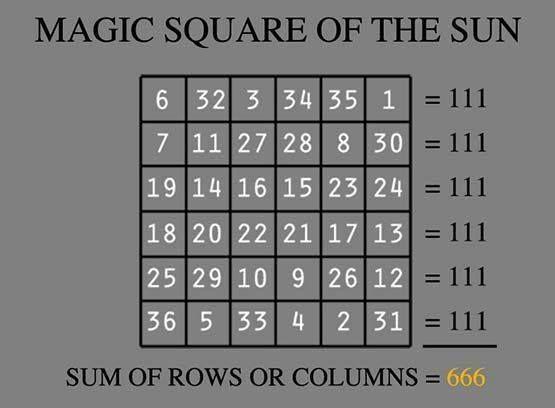
The quote that opens this piece from One Star in Sight appears the best Crowley quote in the book in my estimation. It’s succinct, impactful and provides excellent context the title of the book. The number he refers to in the second line is, of course, 666, a triple affirmation of Tiphareth; 666 = the sum of all the numbers from 1 – 36 (6 x 6); also 666 = 6 x 111 which describes what’s known as the magic square of the Sun.


In 1934 Crowley testified in a libel case he brought against Nina Hamnett for publishing the accusation of practicing Black Magic. The judge asked about his identification with 666. He answered, “It only means sunlight. You can call me Little Sunshine.” 111 = the sum of the Hebrew letter Aleph (ALP) which corresponds to The Fool in the Tarot. James Joyce used ALP for the initials of his female protagonist in Finnegans Wake, Anna Livia Plurabelle. Livia = Life. One can see 666 = 6 x 111 as Tiphareth (the heart chakra) multiplied by Life.

* * * * * *

The last paragraph in “Enduring Magical Biography” cycles back to the first paragraph and to the opening Crowley quote creating an enduring circular work.

In an email to the other Lion of Light editors regarding the Afterword I wrote:

<<<I'll try to sketch in the last paragraph of his piece real quick. Here it is for reference:

"It should also be noted that at the time an improbable find happened in the Egyptian desert and Crowley was shuffling around Netherwood, Robert Anton Wilson was Robert Edward Wilson. Magic might have been afoot then, and there are still so many stars in sight."

Arnott references the beginning of his piece where he begins making an allusion with finding the Harvard doc (“Do What Thou Wilt”) to the Nag Hammadi discovery. This makes an allusive connection in time from when the NH find happened to now, the publishing of Lion of Light. The reader is holding in his hands the equivalent of NH or something as transformative. At the head, he quotes One Star in Sight. That star = a person's True Self = a person aligned with their True Will = union with HGA. "Every man and every woman is a star."

"Magic might have been afoot then ..." afoot = Malkuth = the material world ... with the NH find ..." and there are still so many stars sight" i.e., all the readers holding this book looking to align with their Highest Self. At the time of the NH find, RAW had yet to create his magical self which Gregory chooses to symbolize by becoming Robert Anton Wilson. So, the reader, not yet enlightened, can see that at the time of a previous "great find," the mighty Robert Anton Wilson was merely Robert Edward Wilson, not yet his True Self. If he can do it, and look what he did, so can YOU, dear reader. One Star in Sight, means it's possible, it's immanent.

It seems a very positive message, and good magick, in my opinion. >>>

One may find other such gems or “Easter eggs” in the essay. The beloved deSelby has something important say in connection with Crowley’s Greater Feast. Crowley’s “grandson” in the A.’. A.’. lineage, Jerry Cornelius, would likely agree. It’s one of the central tenets of Thelema.

The consideration of “first contact across time” appears magically suggestive. I take that to mean that if you weren’t around to make contact with Crowley or Wilson during their years on Earth, contact with them may come through the time-binding of the printed page and some conversation with your HGA. “Contact” indicates more than an intellectual apprehension; more along the lines of a gnostic experience. This contact can also be viewed from the perspective of psychometry. One theory of the transmission of esoteric knowledge holds that shamans, wizard, magicians and Sufis of yore had the ability to embed their knowledge in artifacts. This knowledge can get unlocked years, decades, or centuries later if one knows how to do so. These artifacts are called “reading artifacts.” A book called Visions in the Stone by E.J. Gold shows how to practice psychometry. I would guess there’s a parallel or similar methodology between psychometric reception from reading artifacts and the HGA. Learning to converse with the HGA through Tiphareth helps open the doors for intuitive or psychic reception. Lion of Light can and does function as a reading artifact. Of course, a lot of its esoteric information doesn’t have to be unlocked, it’s in plain sight; not all.

When I read Gregory’s first submission, I got the impression that he could be a major writer in this area; it seemed a product of great writing. “Enduring Magical Biography” is also very well written and makes several excellent points regarding Wilson’s take on Crowley. Parts of it are very funny for those who appreciate dry humor, the only kind of humor you can find in the desert where the essay starts and finishes. It has a je ne sais quoi found only in experienced practitioners of Wilson and Crowley.

* * * * * *

A ritual is another sort of reading artifact. The more it’s practiced the more it becomes unlocked and transmits gnosis. It rewards repetition, the Deleuzian kind where each repetition has something different. The Mass of the Phoenix is one of my favorites. It seems particularly appropriate for this time of year. It encapsulates the Great Work of theurgic Magick in a fairly short, but effective practice. It’s found in Chapter 44 in The Book of Lies or right here:


THE MASS OF THE PHOENIX


The Magician, his breast bare, stands before an altar
on which are his Burin, Bell, Thurible, and two
of the Cakes of Light. In the Sign of the Enterer he
  reaches West across the Altar, and cries:

Hail Ra, that goest in Thy bark
Into the Caverns of the Dark!

He gives the sign of Silence, and takes the Bell, and
Fire, in his hands.
East of the Altar see me stand
With Light and Musick in mine hand!

He strikes Eleven times upon the Bell 3 3 3-5 5 5 5 5-
3 3 3 and places the Fire in the Thurible.
I strike the Bell: I light the flame:
I utter the mysterious Name.
ABRAHADABRA
He strikes Eleven times upon the Bell.

Now I begin to pray: Thou Child,
holy Thy name and undefiled!
Thy reign is come: Thy will is done.
Here is the Bread; here is the Blood.
Bring me through midnight to the Sun!
Save me from Evil and from Good!
That Thy one crown of all the Ten.
Even now and here be mine. AMEN.

He puts the first Cake on the Fire of the Thurible.
I burn the Incense-cake, proclaim
These adorations of Thy name.

He makes them as in Liber Legis, and strikes again
 Eleven times upon the Bell. With the Burin he then
 makes upon his breast the proper sign.

Behold this bleeding breast of mine
Gashed with the sacramental sign!

He puts the second Cake to the wound.
I stanch the blood; the wafer soaks
It up, and the high priest invokes!

He eats the second Cake.
This Bread I eat. This Oath I swear
As I enflame myself with prayer:
"There is no grace: there is no guilt:
This is the Law: DO WHAT THOU WILT!"

He strikes Eleven times upon the Bell, and cries
 ABRAHADABRA.
I entered in with woe; with mirth
 I now go forth, and with thanksgiving,
To do my pleasure on the earth
 Among the legions of the living.

He goeth forth.

Notes:

Crowley explains this ritual in Chapter 62 of the Book of Lies which I’ll give below.
Ideally, this ritual is performed at Dusk in front of an open window that looks West where you can see what appears as the sun going down. The student is bare-chested.
I use my magical dagger instead of a Burin and a votive candle instead of a Thurible. My Cakes of Light are saltine crackers. The making of a proper Cake of Light is partially described in Liber Al vel Legis III 23. Finding a suitable Bell can be interesting. One can do knocks if a bell isn’t around, but a bell works much better.

Sign of the Enterer:


Where it says “Fire in hands,” I use a small pack of wood Safety matches.
The sign of Silence can be found online. It’s the classic sign for silence: index finger over the mouth and the left foot steps back.

The last two lines of the prayer gives one description of the Great Work. “Thy one crown” refers to Kether.

Where it says to proclaim the adorations as found in Liber Legis – The Book of the Law, they are:

Unity uttermost showed!
 I adore the might of Thy breath
Supreme and terrible God
 Who makest the gods and death
To tremble before Thee: –
 I, I adore thee!

Appear on the throne of Ra!
 Open the ways of the Khu!
Lighten the ways of the Ka!
 The ways of the Khabs run through
To stir me or still me!
 Aum! Let it fill me!

The light is mine, its rays consume
 Me: I have made a secret door
Into the House of Ra and Tum
 Of Kephra and of Ahathoor.
I am thy Theban, O Mentu,
 The prophet Ankh-af-na-khonsu!

By Bes-na-Maut my breast I beat;
 By wise Ta-Nech I weave my spell.
Show thy star splendor, O Nuit!
 Bid me within thine House to dwell,
O winged snake of light Hadit!
 Abide with me, Ra-Hoor-Khuit!

Then it says to use the Burin to make the “proper sign” on the breast without indicating what this sign is. I just scratch a cross on my chest; it can be whatever sign you wish, but I suggest keeping it simple. Duquette gives some suggestions in his notes to this ritual in The Magick of Aleister Crowley. It’s also implied that one should break the skin and draw physical blood. I do not do this, rather I visualize the “higher blood” pouring forth from my chest to soak the Cake of Light. Duquette gives a safe way to draw blood in his account, but if you’re making this a daily ritual, it seems a little much to scar the chest every day. Visualizing the “blood” works fine for me.

Chapter 62 from The Book of Lies:

TWIG?


The Phoenix hath a Bell for Sound; Fire for Sight; a
   Knife for Touch; two cakes, one for taste, the other
   for smell.
He standeth before the Altar of the Universe at
   Sunset, when Earth-life fades.
He summons the Universe, and crowns it with
   MAGICK Light to replace the sun of natural light.
He prays unto, and give homage to, Ra-Hoor-Khuit;
   to Him he then sacrifices.
The first cake, burnt, illustrates the profit drawn
   from the scheme of incarnation.
The second, mixt with his life's blood and eaten,
   illustrates the use of the lower life to feed the
   higher life.
He then takes the Oath and becomes free — un-
    Conditioned — the Absolute.
Burning up in the Flame of his Prayer, and born
    again — the Phoenix!

Notes:

Twig is an English expression for “do you understand?”
62 corresponds with “healing.”

The music selection is a rock-n-roll standard written by John Fogarty. Rumor has it that Fogarty got turned on to Finnegans Wake by reading Jack Kerouac and wrote Proud Mary in homage; Mary = Anna Livia Plurabelle. “Rolling” could represent a turned on and active heart chakra; we find other Thelemic allusions. It’s most famously performed by Tina Turner and her dancers and band. Tina is 69 years of age in this video. Nag Hammadi is located on the banks of the Nile river.


Love is the law, love under will.


Oz
Sunday, December 17, 2023

Lion of Light: Impotence on this Backwards Planet

Detail from the Stele of Ankh-ef-en-Khonsu


Lion of Light: “The Lord of Force and Fire: A Review of The Law is For All” (pg 215-228)

Do what thou wilt shall be the whole of the Law. 


Published in 1976, this is a “peak” Robert Anton Wilson piece of writing if you consider the Wilson of Cosmic Trigger to be the archetypical “Wilson” persona. It begins with a discussion of Saul Paul Sirag and Dr. Andrija Pujarich’s separate but similar experiences with Uri Geller and his alleged contact, SPECTRA. I don’t think the Sirag who wrote in to Tom’s Rawillumination a few years ago would have much time for the Sirag who experimented with Geller (but that is my perhaps-incorrect impression based on a memory of a comment from years ago) and from what Eric Wagner has relayed here and my own impressions, I’m not sure that the Wilson of the 21st century would have held the same unbridled admiration of Liber AL and Crowley that is related in this introduction. But it is delightful to run across another piece from Wilson so close to the time of Cosmic Trigger’s publication that it read almost identically to that storied volume. 


This piece was a review of the Regardie publication of Crowley commentaries on Liber AL vel Legis that he meant to have published during his lifetime. It was, as the title quote from the book would imply, written to explain the profundities of The Book of the Law. Whether Crowley’s book succeeded in this task is left up to the reader; Wilson gives a sample of these efforts at explication in this introduction with a good natured “[i]s that quite clear class?” as a follow up statement. Your mileage will vary. There are many interesting verses in The Book of the Law; many which Wilson found particularly interesting or illuminated have been repeated across the various pieces collected in The Lion of Light. In this piece, I found Wilson’s confidence in the importance of the Eighties interesting, in light of a fragment of verse in Chapter III: “I am the warrior Lord of the Forties: the Eighties cower before me, & are abased.” It has generally been agreed upon in discussions with others that the “warrior Lord of the Forties” portion is a good whack at prophecy by Crowley or Aiwass, but the importance of the Eighties remains somewhat mysterious. 


Did the Eighties live up to the abasement prophesied in Liber AL? From an American-centric worldview, it could be seen as a time of abasement as economic policies made economic inequality more egregious and certain. It was a time of rising materialism and, if we wish to look at this from an environmental perspective, was a time when the world decided that the findings of the seventies could be ignored in favor of the status quo and global economy. I haven’t read many “official” Thelemic commentaries post-Eighties on this and am curious if anyone knows the “orthodox” interpretation of that decade. (I know that Wilson plays up the individualistic morality of Thelema, but those in or under the auspices of the O.T.O. tend to be (un)surprisingly uniform, at times.)  I wonder what Wilson made of the prophecy, which he seems to very much anticipate coming true in 1976, by the turn of the century. Wilson was obviously displeased with the course of the world during the Eighties, having left the United States to seek refuge in Ireland for part of the decade. Another mystery. 


As a Thelemite, I do agree with Wilson’s enthusiastic endorsement of Thelemic, and more importantly, by association, my morality. I always knew I was a good person. I also agree with Wilson’s assessment that if the true principle of “do what thou wilt” were applied, there would be a great deal more care applied to intra- and interpersonal conduct. Furthermore, I agree with Wilson’s perhaps interminably-human assessment that the progress of human relations has been in decline in the modern era. While we have made vast improvements in terms of race relations and gender equality, there is still a lot to be desired and the ubiquity of the Internet has given us a whole new, occasionally amoral, plane upon which to demonstrate the possibilities of human depredations. But this brave, if sunny, vision, is predicated upon a morality that is well-understood and applied, and humans aren’t very good at that. Far too many would-be Thelemites have already misinterpreted "do what thou wilt" as "do what I want." It is nice to consider the possibilities, though. I do admire, if I occasionally have to mitigate, the somewhat dangerous honesty of Thelemic morality, best exemplified by Crowley’s own insistence on displaying his flaws. That honesty is very, very admirable to me. And I also admire that Thelema demands growth from its adherents and doesn’t allow much time for (blind) self-indulgence. (On the other hand, this moral view is simultaneously profoundly uncomfortable. Your mileage may vary.) 


It will probably come as no surprise that I object to the laissez-faire assessment that a true anthropological view of human morals will render all of them equally absurd and/or meritorious. I must insist that I see some belief systems as entirely unworkable with my idea of civilization, which, after all, is the one I am generally concerned with. The rise of Christian nationalism and authoritarian values in the West serve as an ever-present reminder that some reality-tunnels are much harder to deal with than others. I have no time for equivocation during these years. We must tend to our garden and it is best to mind our own business, yes, but there really isn’t any call for the absurdism of being above-it-all. One must care about the soil that hopefully nourishes one’s garden. It depressed me to read Wilson’s confidence in the following line: “He opposed Christianity in general and Christian sexual morality in particular; and Christianity, especially its sexual morality, is everywhere in contemptible decline.” While this statement still holds statistically true, we can see that the rabid old dog still has teeth. Fundamentalism is incompatible with Thelemic morality and the Thelemic vision of a free world. 


As a final word on the Wilson of 1976’s confidence in Crowley’s importance, his litany of examples of how Crowley might have changed society is admirable and thought-provoking. Crowley’s influence on the occult is difficult to over-emphasize, and we must wonder how much of New Age thought would exist without him. His influence on art seems to be an easily-overlooked, occult, if you will; this seems to be a certainty, when one looks closely into the weave of the tapestry of culture. In Stranger Than We Can Imagine, at the end of the chapter on Individualism, Higgs wryly points out that there were more Jedi in Britain than Thelemites on the last census in the United Kingdom and suggests that Crowley’s ambitions to change the world were in vain. I think that Wilson might have disagreed. 


Happy Holidays, everyone! I imagine this will be “Happy New Year” as well. Oz and I will be on hiatus until the new year when we’ll come back together to discuss the final pieces  in Lion of Light. Until then…


Love is the law, love under will. 


Saturday, December 2, 2023

Lion of Light: Cloaked In Uncertainty

Scene from The Yellow Methuselah. Photo by Ira Cohen

Lion of Light: The Hidden Heritage – Foreword to Charles Kipp’s Astrology, Aleister & Aeon p. 195 - 213


Do what thou wilt shall be the whole of the Law

“. . . Crowley remains a mystery inside a puzzle within a controversy cloaked in uncertainty.” After 28 years of research and experimentation into the Man, the Myth, and his Magick, Wilson provides this open-ended, bottomless, agnostic description of the subject he’s considered an expert on. His expertise on Herr 666 must explain why he nabbed this assignment. Kipp’s book uses Aleister as a focal point to write about Astrology, or so says the description on Amazon, I have not read the book myself. If anyone reading this has, what do you think of it? It seems a little surprising to find Wilson writing a Foreword to a book on Astrology given that he didn’t care for it. We find only the slightest of allusions to the subject in a quote from Crowley’s Gnostic Catholic Mass: “I believe in one Star in the company of Stars of whose fire we are created, and to which we shall return; and in one Father of Life, Mystery of Mystery, in his name CHAOS” appearing at the very beginning and again at the end to nicely frame the piece. You won’t find one word about the book this is a Foreword to.

I have only a superficial understanding of Astrology, maybe because I came up through the Wilson school of magick which didn’t direct much attention to that area. My father, the physicist, showed interest in it; unfortunately I didn’t get the opportunity to discuss it with him. I discovered it only after he left his mortal coil. He had a number of books on Astrology that I inherited including some basic texts on how to go about understanding and applying it. I took a crack at learning Astrology through these to no avail. However, I do think there’s something to it. I have friends I respect who are experts in the field. I also consider the astrological portent about timing certain events through drawing Tarot cards. Each of the Trumps, except The Fool, The Hanged Man, and The Aeon correspond to an astrological figure. Those three correspond to the elements Air, Water and Fire. The Universe card does double duty corresponding to Saturn and Earth (the element). Each of the small cards of the Minor Arcana represents one decan (10 degrees or 10 days of the zodiac belt.) The astrological aspects of the Tarot gets explained very well in Duquette’s Understanding Aleister Crowley’s Thoth Tarot.

Uncle Al did know astrology inside and out. It’s well known that he was a ghost writer for Evangeline Adams, a very popular New York based astrologer. He wrote two best-sellers for her: Astrology: Your Place in the Sun and Astrology: Your Place Among the Stars both of which came out under Adams’ moniker with no mention of Crowley. He finally received credit with the 2002 publication of The General Principals of Astrology, Liber 536 that included his material originally written for Adams. It also includes the birth charts, with ample explanation, for 193 famous people including luminaries such as Shakespeare, Dante, Mark Twain, Winston Churchill and Napoleon. In Confessions, Crowley claimed the ability to guess the rising sign at a person’s birth based on their appearance. Naturally, he kept track of his guesses and found he was right two out of three times. Anecdotal evidence in one of his biographies backs this up.

Wilson sets the stage, the mise en scene for Astrology, Aleister & Aeon in “The Hidden Heritage” by constructing a concise history of Hermetic secret societies and their place in the world starting with Freemasonry, moving to the Rosicrucians, and the Illuminati, then leading to the Golden Dawn, the O.T.O. and finally, Crowley. He sees Golden Dawn elements in the literature of Pound, Eliot and Joyce. I saw some in Proust who was related, through marriage, to Macgregor Mathers. It’s a brilliant and very informative history of these groups and how popular opinion reacted and responded to them.

RAW’s foreword has some excellent literary tricks/easter eggs; two that I know of. Wilson on Crowley:

“’Thank God I’m an atheist,’ he once wrote piously and that’s not anywhere near the peaks of paradox he employed to both reveal and conceal the meanings of his very hermetic books.”

The essay has other paradox or paradox-like tropes starting with the opening quote: “ I believe. . . (famously, he has said, “I don’t believe in anything”).The piece starts by ranking Crowley against a backdrop of the 20th Century’s worst thugs then turns around and compares him to brilliant people while throwing in Kennedy and Bill Clinton for comic relief. He first section, Something Wicked This Way Comes named from a Ray Bradbury story, also an excellent film. That’s followed by the next section, Light in Extension.

The s +c letter code I may have mentioned once or twice previously in my uncollected works gets a little nod here. Apart from Wilson, this code gets employed by Rabelais, Aleister Crowley, James Joyce, Robert Heinlein, Gilles Deleuze and Thomas Pynchon that I know of. Pynchon explicitly identifies this code as a code in his Introduction to Slow Learner. In “The Hidden Heritage,” I first noticed it on page 199 as part of the light bulb changing riddle: “That’s a Craft secret.” Then, in the footnote on p. 201 “Copernican system of astrology.” Next, at the top of p. 208: “. . . revealed the secret clearly;” and at the bottom: “’support and congratulations.’” In the penultimate paragraph Wilson repeats a phrase he used earlier about a mystery inside a puzzle . . . then adds a different ending: “ . . . and yet still strangely concealed . . .” Some of these may have been coincidences, who knows? But then we see the word CHAOS (caps in the original) ending the opening quote as well as the last word in the piece, which starts with a C and ends with a S. The first sentence in Ulysses begins with an S; the last word in that long” sentence begins with a C. We find Wilson doing the same with the first section header. He was known to sometimes model his writing after Joyce. If this seems far-fetched, precedent for this kind of letter encoding and more gets identified in Tindall’s Guide to Finnegans Wake and Campbell and Robinson’s Skeleton Key… with the letters HCE and ALP.

The mystery of the lost “word” of the Freemasons comes under discussion, with the suggestion, based on Egyptian mythology, that this “word” = entheogen drugs. Support for this view comes from chapter 72 in Confessions where Crowley claims that he knows this lost word, without revealing it. Wilson deduces that he means these kinds of drugs because Crowley majored in organic chemistry and he offered them to the audience at his Rites of Eleusis performance series. True to form, RAW then offers an alternate model – tantric sex as the lost word. An informative lecture covering Crowley on drugs is presented by Richard Kaczynski here:


The part about his drug experimentation begins around 15:30 and concludes around 57:00.

On p. 203, Wilson says: “Bernard Shaw’s Back to Methuselah owes much to syncretic Golden Dawn ideas he probably learned from Florence Farr . . .”

Florence Farr was an actress, active feminist and an adept in the Golden Dawn. In “The Hidden Heritage” RAW claims that she was also the mistress of Shaw, Yeats, and Crowley. I haven’t been able to verify her romance with Crowley. The all-wise internet only says there was much speculation about it and that Crowley was certainly enamored of Farr, basing the character of Sister Cybele in his novel Moonchild on her. Farr was said to be present at Crowley’s initiation into the Golden Dawn, but she was also one of his superiors in the Order who refused his 5°=6° Adeptus Minor initiation siding with Yeats against Mathers and Crowley in the famous schism that eventually broke up the original Golden Dawn.

Back to Methuselah is an epic play, it can run up to 6 – 7 hours, yet it did have performances on Broadway and other prominent theatrical venues. In 1982 at New York’s Joyce Theater, I saw the Living Theater’s production of The Yellow Methuselah based on Shaw’s play and Kandinsky’s The Yellow Sound and it blew my mind. The setting of it ranged from the Garden of Eden to several thousand years in the future. The Living Theater was known for breaking down the fourth wall and inviting audience participation. I remember cast members costumed like sprites running though the audience whispering to us, “in the future, all is poetry” like a mantra. Shortly before the intermission, this surrealistic offering convened a panel on stage consisting of characters of famous people, including Bernard Shaw, discussing a now, alas, forgotten philosophical question. After the panel gave their responses, it was decided to ask the audience in the front two rows. A mic was passed around and people gave their opinions. After the 15 minute intermission, they came back with an answer to this question which consisted of playing back an edited tape recording of the audience’s answers. I was impressed with the speed they had put it together, long before computer digital editing; done on the fly, the old-fashioned way, with tape and a razor blade.

The word “syncretic” quite accurately used to describe the Golden Dawn in the above quote also seems a profitable approach to personal voluntary evolution: use what works for you from any system, religion, mythology, work of literature, piece of music, etc. and discard or pass by what you don’t need. Model Agnosticism lends itself to a syncretic strategy for Initiation.

Another sentence beginning at the bottom of p. 202 stood out for me. Included in the description of the Golden Dawn we find: “This was combined with a profound study of Christian Cabala, a derivative of the original Jewish Cabala, a science or art influencing occult society which provides a religious language and numerology to discuss and clarify various altered states of consciousness.” (I’ve corrected the typo that occurs in the text – “influential” should read “influencing.”) Many people don’t bother to tackle Cabala as learning it feels like a monumental and daunting task. I will share how a very lazy person, myself, Picked it up a little at a time.

1. Procure a copy of 777 and Other Qabalistic Writings of Aleister Crowley.


2. Write down all the correspondences for key 6, Tiphareth. Pay attention when you encounter one of these correspondences as you go about daily life. For instance, seeing a Buddha statue, a Calvary Cross, a rose, a lion (if you happen to live in Africa or are at the zoo) or a see a book with “lion” in the title (very rare, I know) or even hear a song about a lion like “The Lion Sleeps Tonight,” anything that strikes you as particularly beautiful, etc, etc. etc. I combined this with an exercise to invoke/make contact with a deity connected to Tiphareth. For that, I worked with “Liber Asarté vel Berylli” found in the Appendix of Magick, Book Four which I modified to comport with my situation. 


3. Procure a poster or a large photo of the Qabalistic Tree of Life. Put it somewhere where it’s comfortable to absent-mindedly gaze at, see and ponder. I used the cover illustration to Dion Fortune’s The Mystical Qabalah pictured below. Posters of this were still available when I looked for one for a student a few years ago. Eventually, you will want to read something that outlines and explains the Sephira (spheres) and the paths that connect them. Fortune’s book provides an excellent study and there are others. In the course of this you will pick up the Hebrew alphabet, each letter corresponds with a path on the Tree. The first time I saw a diagram of the Tree of Life was on the back of a Todd Rundgren concert t-shirt. It had “Healing” on the front which was the name of the tour and his new album at the time. I saw it 2 or 3 days following the Living Theater performance mentioned above. Working with Tarot cards is another painless way to absorb Cabala.


4. Read the fiction of Robert Anton Wilson beginning with Illuminatus! Read Cosmic Trigger I.

5. If any particular number recurs frequently and/or you experience a strong synchronicity with a number, look it up. Apply your intuition (which becomes stronger with use) to decipher what, if any, meaning it has for you. 
 

6. Learn to transpose words to numbers then look up the number in “Sepher Sephiroth” (back of 777.) There is a chart there to transpose English and Hebrew letters to numbers. All the English letters are there except: F which I usually connect with Vau (6) because they’re both the sixth letter of their respective alphabets. Traditional Hebrew corresponds F with Peh (80). You can do it however it makes sense to you. I also ascribe “W” to Vau. The letter V is also there with Vau though traditional Hebrew has a variation connecting it with Peh. The letter X is missing from the chart, I put it with Tzaddi (90).


Also useful – “The Meaning of the Primes from 11 to 97” list on page xxv. Look up 23, for instance, if you happen to break out in a rash of coincidences with that prime (also very rare, I know). It gives the meaning: “The glyph of life – nascent life.” Perhaps this can indicate spiritual life or, as Timothy Leary prefers, extra-terrestrial life?


Contrary to Crowley’s instructions, I’ve never memorized any of the Qabalistic tables. Some things naturally become memorized through frequent use. As indicated above, Wilson says much of modern literary culture owes its symbolism and themes to the Golden Dawn and cites Yeats’ poetry, Ezra Pound, Eliot and Joyce as examples. I would add Thomas Pynchon. Learning Cabala will aid one’s understanding and appreciation of this literature.


Love is the law, love under will.

Oz

Thursday, November 23, 2023

Lion of Light: Hazardous to Your Dogma

Forgot to mention Seabrook below, he's another of Crowley's mostly-unreliable mid-century biographers.

Lion of Light: Foreword to Scott Michaelsen's Portable Darkness (pg. 187-193) 

 Do what thou wilt shall be the whole of the Law. 


I’m really happy that the order of Oz’s and my  responses to Wilson’s pieces on Crowley landed me with the forward to Portable Darkness. Not because I have anything particularly profound to share, but simply because this piece is important to me; it was one of the first pieces I read on The Great Beast that seemed promising and inspired me to continue deciphering the shadow-language of occultism. In many ways, the Lion of Light has been a walk down memory lane, a collection of works I had sought out or found in my hands but that had never before been concentrated in the same place. I cannot properly express how impressed I am with this collection: as I have said before, and will most likely say again, I wish I had had this collection when I was a novitiate. 


That said, even as someone who has spent years immersed in this milieu, there are still some mysteries in Wilson’s forward. I have never been able to identify the Wheatley story that chronicles the death of MacAleister and the elder Crowley’s institutionalization. I will admit I still haven’t read most of Wheatley’s fiction aside from The Devil Rides Out. He was prolific and much of his work is out of print; Wheatley helped shape that peculiar British tradition of being a man who was fascinated by the occult but drew a hard moral line between study and practice. His heroes are usually those who have only righteously dabbled instead of committing themselves towards black magic and are only interested in countering the diabolic machinations of actual practitioners. Wheatley also shamelessly capitalized on the occult revival of the 60s by releasing the curated collection of occult fiction “The Dennis Wheatley Library of the Occult.” I have a copy of Crowley’s Moonchild released under that imprint, so that shows how truly dangerous and evil Wheatley thought Crowley’s writing was. That, or he wasn’t afraid to unleash the dark energies of the Great Beast upon an unsuspecting public. Robert Irwin’s exceptional Satan Wants Me, set during the aforementioned revival, contains a humorous portrait of Wheatley, something that one suspects is inspired by Irwin’s own life experience. The hapless protagonist has found out that his involvement with a magical lodge has resulted in all-too-real consequences and writes to Wheatley for advice; the old author replies with a stodgy missive that scolds him for drug use, provides a facile and overblown warning about dabbling with magic and then encourages the protagonist to buy his latest book. Irwin’s autobiographical Memoirs of a Dervish has a few real life instances of the “luminaries” of mid-Century occult scholarship acting rather unimpressively. 


Wheatley’s novel was adapted into a fantastically lurid Hammer Studios film, released as The Devil’s Bride in America, that stars Christopher Lee as the virtuous Duc de Richlieu and Charles Grey as the Crowley-inspired Mocata. I highly recommend it. 


What was more troubling to me for years is that I never ran across the story of MacAleister’s unfortunate fate anywhere else, and I would relish reading the repetition of such a stone-faced canard. I love Crowley’s various fictionalized versions, deeply. That isn’t to say that I disbelieve Wilson- there was a mild boom of paperback and zines during the 60s that specialized in crude, inaccurate accounts of magical practice and demoniacal cults. Bereft of much literary merit, few of these publications were preserved. Once, a bookseller who knew my tastes well invited me into his backroom where he revealed a box of such titles, gathered from an estate sale. Although very broadminded, I think the salacious titles and cover art made him wary of putting the books on his shelves. I flipped through the lot, but could find very little of any use. Perhaps I should have purchased the collection for further perusal, but I only selected a couple of the titles with the most risque covers which I promptly lost between loaning them out and various moves. I think Uncle Al appreciated most of his caricatures, or at the very least took them in his stride. It is through these fictionalizations that we can best appreciate the dark dynamic of Crowley that Wilson writes about before trying to disabuse the reader of it in his foreword. 


I have never, to my satisfaction, identified the six biographies that Wilson was writing about in particular. There were more than six biographical accounts of Crowley published by the time of this foreword, and with the widened lens provided by the Internet, I cannot confidently guess at which ones would have flown across Wilson’s radar during this time period. One can assume that at least some of the hostile biographies would have been The Great Beast by John Symonds and Francis X. King’s The Magical World of Aleister Crowley; perhaps a third would have been Daniel P. Mannix’s The Beast: The Scandalous Life of Aleister Crowley. I would imagine at least one of the “sympathetic” biographies would have been Regardie’s The Eye in the Triangle with the other perhaps being Gerald Suster’s biography or Charles Cammell’s (father of Performance co-director Donald Cammell) Aleister Crowley: The Man, The Mage, the Poet. These are some of the inconsequential questions that have bothered me throughout the years. Lord knows we have more than enough Crowley biographies today, but I would like to reconstruct where Wilson’s knowledge was partially derived from. 


On a related note, I have never ran across the utterly charming bit of verse that Wilson profers as “the quickest introduction to the real Aleister Crowley”:


By all sorts of monkey tricks
They make my name mean 666; 

Well, I will deserve it if I can:
It is the number of a Man. 


I’ve had this down by heart--it isn’t hard--since first reading this piece so many years ago; I love it, but haven’t found it in Crowley’s writings. Perhaps it is derived from his diaries, which I haven’t read all of and will admit that I didn’t read particularly carefully when I did dip into them. I’m hoping one of our astute readers might be able to point me in the right direction. I’ve raised a lot of questions here, and would appreciate anybody’s ideas or attempts at answers. I do think that some valuable insight is gained herein as towards Wilson's attitude towards Crowley and all his foibles later in his writing career.


Finally, a word on “Portable” anthologies. The Viking Library was famous for its “Portable” titles and I typically disdained them. Perhaps I had prematurely, through some temporal fluke, taken Crowley’s own words to heart that I wouldn’t read until years later; in his autohagiography, Crowley writes that his understanding of literature was so expansive because he read all of the works of an author, not just a few titles, while discussing Coleridge. I disdained the Portable Library as something beneath me and fell into the trap of believing that it is better to read nothing rather than excerpts. This arrogance cost me a few years of understanding. It was Portable Darkness that introduced me to a lot of the more lucid parts of Crowley’s corpus; I first read excerpts from Magick Without Tears and Eight Lectures on Yoga in that compendium. It would also be in The Portable Joyce that I would first read any part of Finnegans Wake. So, I recommend reading something over reading nothing. Portable Darkness was not part of the Viking line of books, but it did capitalize upon the trends. Aside from the fact that Scott Michaelson didn’t seem to believe in any of the practical bits in Crowley’s writing, it is a very good anthology and our editor does display his good taste by including most of the poems, sans commentaries, of Wilson’s beloved The Book of Lies. This was also the book wherein I first read Liber AL and a few of the very best of the Holy Books of Thelema. If the collection had included Liber E and Liber O, I would say it is a near-perfect introduction. Even without those foundational texts, it is still a great introduction, replete with further reading recommendations, "marvellous commentaries" and compiled by someone who recognized Crowley’s philosophical and literary merit. 


Love is the law, love under will.


A.C.


TESTAMENT #13 "Babel (Part I) - Preaching to the Converted"

LINK TO FREE WEB COMIC VERSION OF TESTAMENT #13 (NSFW) Quick reminder that TESTAMENT can get pretty explicit! Original solicitation copy fo...