Member of the NEW TRAJECTORIES WEBRING

Sunday, September 17, 2023

Lion of Light: Collect Your Wits and Hop On Board


Oz Fritz (from Hilaritas Press)


Lion of Light: "Five Footprints of a Camel" A Foreword by Oz Fritz

(Theory)

Do what thou wilt shall be the whole of the Law.

It has been noted before that Crowley derived the name “Aleister” from Percy Bysshe Shelley’s “Alastor, or The Spirit of Solitude.” Crowley derived the first title of his Autohagiography from Shelley’s poem, which also gives us a pretty solid clue how he envisioned himself. Shelley’s poem is about a Poet trying to discern the ultimate nature of reality in a search for the supernatural that takes him past the boundaries of the natural world (naturally, nich whar?) and towards that mysterious shore from whence no one returns. The name “Alastor” was actually suggested to Shelley by none other than Thomas Love Peacock, author of Nightmare Abbey, a deeply humorous work from whence we derive the quote that diagnoses so many wanderers of the waste: “You talk like a Rosicrucian who will only love a sylph, who does not believe in the existence of a sylph, and who yet quarrels with the entire Universe for not containing a single sylph.” (Peacock directs this to the Byron-analogue, “Mr. Cypress,” not Shelley’s, but the sentiment holds true, at least as far as “Alastor” is concerned.) It should also be noted here that Crowley, while on his honeymoon with Rose Kelly, spent the night in the King’s Chamber of the Great Pyramid of Giza where he performed the Bornless Ritual in an attempt to show the sylphs to his new wife. 


Rose did not see the sylphs, or Crowley failed to “shew” them, but she did enter into a trance state and uttered the cryptic “They’re waiting for you.” Crowley was unimpressed; yet, this was the beginning of the Cairo Working. Alastor, Shelley, Peacock, Cypress and Aleister were all very accustomed to the parade of hunchbacks that we are subjected to as finite beings composed of fiction and reality. While few men could be defined as truly content, Crowley was decidedly not content with this state of affairs. And yet, when the soldier(s) appeared over the course of three days in the form of Aiwass and his wonderful and terrible message, Crowley found himself back to the march of hunchbacks. If we are to believe Crowley, and I see little reason to not believe that Crowley believed what he attested, he resisted the message of Liber AL for years before accepting the Law of Thelema. Aiwass even mocks Crowley’s reluctance in receiving his message in the verse “I see thee hate the hand & the pen; but I am stronger.” Crowley set out for answers, found them and tried to reject them, leaving us with the questions: what do we do when the hunchback throws out his chest and stands up straight, but we despise the soldier standing before us?


If we are Aleister or Alastor, we endure until the end, gradually accepting the state of affairs that Fortune has been/is being revealed before us. If we are Robert Anton Wilson, we keep questioning until the very end. Either way, we know that the soldier shall soon turn back into a hunchback. We are all wandering across the desert of finite existence, in search of the infinite. If we are A Student, we are well advised to go to Wilson to better understand Aleister. But our teacher won’t give up his teacher’s secrets easily. We must come to understand in fullness on our own. 


Our wonderful wizard Oz passes some of the baraka of Wilson concerning the question of what to do with our hunchbacks concerning Crowley in his foreword by recalling his own Work. “Five Footprints of a Camel” begins with Oz recounting his time in Wilson’s online “Crowley 101” course for Maybe Logic Academy. I am sure that most of us know that Wilson didn’t always write about or extrapolate Crowley in the traditionalist manner; Oz points out that Wilson didn’t reference Crowley’s essay “The Soldier and the Hunchback: ! and ?” directly in his assignment on those two punctuation marks, but rather the first two chapters of  The Book of Lies. Let us compare Oz’s experience in Wilson’s class with Sir John Babcock’s first encounter with the Soldier and the Hunchback in the aptly named Masks of the Illuminati


“A large poster announced:

TONIGHT AT 8

“The Soldier and the Hunchback”

a lecture on mysticism and rationalism

by Sir Aleister Crowley

free to all


Sir John picked out a Crowley volume entitled, with Brazen effrontery, The Book of Lies. Opening it, he found the title page: 


THE BOOK OF LIES

WHICH IS ALSO FALSELY CALLED

BREAKS

THE WANDERINGS OR FALSIFICATIONS
OF THE ONE THOUGHT OF
FRATER PERDURABO

WHICH THOUGHT IS ITSELF

UNTRUE


Despite himself, Sir John grinned. This was a variation of the Empedoclean paradox in logic, which consists of the question: “Empedocles, the Cretan, says that everything Cretans say is a lie; is Empedocles telling the truth?” Of course, if Empedocles is telling the truth, then- since his statement “everything Cretans say is a lie” is the truth- he must be lying. On the other hand, if Empedocles is lying, then everything Cretans say is not a lie, and he might be telling the truth. Crowley’s title page was even more deliberately perverse: if the book is “also falsely called Breaks,” then (because of the “also”) the original title is false, too, and it is not a book of lies at all. But, on the other hand, since it is the “falsifications…of the one thought…which is itself untrue,” it is the negation of the untrue and, therefore, true. Or was it? 


Sir John turned to the first chapter and found it consisted of a single symbol, the questions mark:

?

Well, compared with the title, that was at least brief. Sir John turned the page to the second chapter and found equal brevity: 

!

What kind of a joke was this? Sir John turned to Chapter 3, and his head spun: 


Nothing is.

Nothing becomes.

Nothing is not.


The first two statements were the ultimate in nihilism; but the third sentence, carrying nihilism one step further, brought in the Empedoclean paradox again, for it contradicted itself. If “nothing is not,” then something is… 


What else was in this remarkable tome? Sir John started flipping pages and abruptly found himself facing, at Chapter 77, a photograph of Lola Levine. It was captioned “L.A.Y. L. A. H.” The photo and the caption made up the entire chapter. Lola was seen from the waist up and was shamelessly naked, although as a concession to the English morality her hair hung down to cover most of her breasts. 


Sir John, on a hunch, counted cabalistically. Lamed was 30, plus Aleph is 1, plus Yod is 10, plus second Lamed is 30, plus second Aleph is 1 again, plus He is 5; total, 77, the number of the chapter. And Laylah was not just a loose transliteration of Lola; it was the Arabic word for “night.” And 77 was the value of the curious Hebrew word which meant either “courage” or “goat”; Oz.” 


Shall we consider how Sir John compares with our courageous goat? Firstly, Oz is playing with you, dear Reader; he notes that “[t]radition holds that one doesn’t speak directly of Cabala. RAW followed that tradition in the course despite Cabala being foundational to the structure of Crowley’s teaching.” He proceeds to not follow Wilson’s example by giving us an example of Wilson not following this tradition, though to the layman it may seem as if he persists in being gnomic, through the application of practical Qabalah. Secondly he has consciously or subconsciously modeled his account of illumination after Wilson’s magical protagonist in Part IV of Masks while noting that The Widow’s Son is “perhaps his most advanced transmission of Magick.” The qabalistic analysis is apparent in Masks; The Widow's Son is derived from less direct, if just as potent, sources. We are drawn away from the heart of the matter towards another. More wanderings in the waste for you, Reader. But through wandering, one can learn much and more. (Oz does give us one more hand in the direction of Masks when he discusses the interchange between Joycean language and Crowleyean magic; Joyce is one of the main characters and expositors of what is happening to Sir John in the novel.) 


Here I’ll provide another way to cut through this Gordian knot (aside from saying “There is God”): focus not on the Empress path, which is far above us, running from Binah to Chokmah anyways, and direct thyself towards the path of the High Priestess. We should at this point imagine ourselves lost in the-Sphere-that-is-not-a-Sphere, Da’ath, upon the Tree of Life; let us envision it as a great broken landscape, filled with ego-shadows and ego-destroyers, step carefully. Let us see ourselves as Sophie Bangs and Barbara Shelley in the lamented Promethea, unbound from our Creator and our Selves; we are lost. All at once we are met by a traveler on camelback, none other than Crowley herself. She is playacting (or realizing herself) as a male Empress: Alice. She offers us some cryptic hints about the path from Tiphereth towards Kether. These hints aren’t much help, but as she recedes we see in the sands in her wake the five footprints of a camel. 


Perhaps this isn’t doing you any good, Reader. Let me try again: you have found yourself back with Sir John in Part IV- Crowley is giving a lecture on the Soldier and the Hunchback. But this isn’t the same as the essay contained in the The Equinox; sure, it hits on some of the same notes, but the propositions are more succinct, more modern. (Since when does Crowley have a Brooklyn accent?) We are being led to some sort of well, how shall we interpret this? As we listen to Crowley lecture with great erudition and felicity on the infinite we drift a little, contemplating our decisions, only to come back and hear him say: “But all this is not the true infinite. It is only what our little monkey minds have been able to comprehend so far. Ask the next question. Seek the higher vision.” 


Five footprints beyond our little monkey-minds: follow those and we'll see that we must conquer in the Aeon of the crowned and conquering child. Oz gives it to you plainly enough in the text. He also gives us the formula for our campaigning: Work. Work and exploration is the only way OUT. Oz also helpfully points towards another way to begin taking the next step- early in his forward, he alludes to the work of Lon Milo Duquette as someone else who is "direct, engaging and often humorous" in his elucidation of Crowley’s work. Perhaps this is unhelpful at this juncture, but Duquette, in his “Few Words of Introduction,” quotes Grady McMurtry saying, as the Outer Head passed him The Eye in the Triangle; that the book was full of “[s]ex, drugs, magick, aliens, conspiracies.” This is an accurate description of the first volume in Illuminatus!, but Masks is all of that in a much more condensed way with a lot more Joyce and Einstein thrown in so we can at least pretend we’re aping at modernity. Duqeutte’s reproduction of Wilson’s Adam Weishaupt award also quotes The Widow’s Son. With this many crossed circuits, at this point I think it might be necessary to ensure we’re taking some joy in our wandering-work. 


Brother, stretch out thy hand, the steps are hard. Oz has provided you with a way forward strewn with blossoms of advice plucked from Wilson’s garden; we have Oz recounting Wilson viewing Crowley through the lens of forgiveness, in an especially poignant moment. We are reminded of Wilson’s eclecticism, which might seem obvious but the particulars are always helpful for remembering; I was particularly fascinated by Wilson’s Crowley-Gurdjieff comparison. Synchronicities and experience adorn Oz’s forward like spice. Our wanderings have become our homes and we must tend to the flowering. Perhaps Odyssesus would have arrived on the shores of Ithaca sooner, had he proceeded on camelback. Considering Oz’s final Maybe Logic message to the waning Wilson, I smiled, for I imagined it was welcomed by Wilson and reminded him of what he had accomplished and continues to accomplish. So, I deem it best to conclude the post-proper where Oz concluded his forward: Ewige Blumenkraft! 


 “The flowers come back every spring. Earth to earth, dust to dust, merde to merde. Every spring the flowers come back…” - Robert Anton Wilson as James Joyce 


Love is the law, love under will.


A.C. 


Next week we'll begin Lion of Light proper with "Starbride" and the first eleven segments of Wilson's "The Great Beast."

(Practice)

- Crowley's "The Soldier and the Hunchback: ! and ?" from The Equinox, Vol. 1 No. 1

- Wilson's Crowley's "The Soldier and the Hunchback" can be found in Masks of the Illuminati (pg. 267-270 in the most recent Dell edition)

- Issue 20 of Promethea is titled "The Stars Are But Thistles" and can be found in the collected editions of that work...Volume 4 in the five volume trade paperback print

- Crowley's "Dust Devils" or Chapter 42 from The Book of Lies

- Prop Anon, Wilson's biographer, has posted the coursework for Wilson's Maybe Logic "Crowley 101" class here.

- Oz seems to be lousy with quarters lately, so I'm trying to keep my eyes peeled. Maybe consider that along with Liber Resh.

Sunday, September 10, 2023

Lion of Light: Time Machine


Lon Milo Duquette (from his author profile)
Richard Kaczynski (from his "X" profile)

Lion of Light: Introduction and Forward


Do what thou wilt shall be the whole of the Law.


Let’s take a look at possible explanations for beginning with this enigmatic sentence known as the Law of Thelema. Why did Aleister Crowley instruct all communications to start this way and conclude with “Love is the law, love under will.?” Not only written communication, he advised Thelemites to pass along this greeting every time when beginning speaking to someone. In this neck of the woods, it’s customary when making a transaction at a store for the cashier to say something like: “Hi, how are you today?” Taken literally, a practicing Thelemite should respond,  “Do what thou wilt shall be the whole of the Law. I’m fine, how are you?” That sounds ridiculous, the cashier might likely think wtf are they talking about? although we can find several accounts where Crowley does just that upon meeting someone for the first time. A Thelemic corollary to this opening remark is: “Every man and every woman is a star.” Another way to approach this opening injunction without completely ignoring it is to say it silently, without the intent of passing the instruction along – for the most part, telepathy remains quite weak at this primitive stage of human civilization, they won’t (not can’t) hear your thought . . . though some will, you may be surprised – but to remind yourself to acknowledge and respect their right to be who they are and to do what they do. In this regard, it appears similar to the Hindu salutation “namaste” which means “the being in me honors the being in you.” This kind of exercise might cotrespond to what John Lilly calls metaprogramming the human biocomputer. When or if it’s practiced enough times, it becomes baked in to what’s known as the “body of habits.” The linguistic formulation no longer becomes necessary. That kind of respect for strangers becomes part of your default mode, until proven otherwise.


“Do what thou wilt” did not originate with Crowley. The earliest I know of it comes from Augustine of Hippo sometime around the 5th Century c.e.: “Once for all, then, a short precept is given thee: Love, and do what thou wilt: whether thou hold thy peace, through love hold thy peace; whether thou cry out, through love cry out; whether thou correct, through love correct; whether thou spare, through love do thou spare: let the root of love be within, of this root can nothing spring but what is good.” Bob Dylan has a song that begins: “I dreamed I saw St. Augustine alive as you or I.” Some 1200 years later in the 17th Century c.e. Francois Rabelais made “Do what thou wilt” the one rule of his fictitious Abbey of Thélème in the novel Gargantua. Crowley flipped St. Augustine’s command to put love under will. Augustine says no matter what you do, do it with love. Crowley wants you to determine what to do, what course to take, THEN do it with love. Carlos Castaneda  puts it as “follow the path with heart.”

It's understandable why St. Augustine and Rabelais used the archaic “thou” instead of “you,” but why Crowley? After all, he endeavored to align Thelema with the method of Science. Why not, “Do what you wilt shall be the whole of the Law?” Or, “do what I wilt?” “Thou” is defined as a second person singular pronoun. When applying “Do what thou wilt” to yourself, it implies something different, something other than how you see yourself now. “You” is also a second person singular pronoun, but it doesn’t have that same effect for suggesting something other than your current “self”; maybe because it’s not archaic? To me, “thou” suggests a becoming, becoming something other than your current self-identity, commonly known as the ego. “Thou” indicates a process, “you” defaults to a static identity. In Thelemic terms, what kind of process, becoming what? What might ‘thou” suggest in “Do what thou wilt shall be the whole of the Law? One might get a clue by reading Stranger in a Strange Land by Robert Heinlein where “Thou” gets a clear, if mystical representation. I share the suspicion with some others that Heinlein was asked by his friend Jack Parsons to give an account of Crowley’s philosophy and Stranger is what he came up with. The Book of the Law does get a mention in it. One could also find a clue from reading/performing the ritual known as “The Mass of the Phoenix” found in Chapter 44 of the Book of Lies. In that regard, Crowley presents the idea of the “Bud-Will” in the 86th chapter of Liber Aleph, “On the Complete Formula.” It’s basically a ritual designed to begin the process of discovering one’s True Will seen metaphorically as the beginnings of a plant that will eventually bloom. 


Lon Milo Duquette begins his Lion of Light “Introduction” with:

Do what thou wilt shall be the whole of the Law. He begins the short blurb he wrote for the back cover with the same words.


* * * * * *


Aleister Crowley and Robert Anton Wilson were introduced to me at roughly the same time by my friend and roommate Bob Gregory. I was 21 or 22. Meeting Bob seemed serendipitous as it resulted from my first personal experience with backstabbing music business politics. A music store salesman whom I respected didn’t like the band I worked for. He lied to me saying they intended to replace me. I quit that band and joined another one that Bob ran lights for. Bob was fond of saying that Bob spelled backwards is still Bob. He had a small occult library that he took on the road with him that included Gems from the Equinox, a best of anthology from Crowley’s Equinox volumes. He also told me about this incredible book that I just had to get, Cosmic Trigger, The Final Secret of the Illuminati by Robert Anton Wilson. Esoteric titles seemed difficult to find at that time in Western Canada where we toured. Fortunately, I found a copy of Cosmic Trigger before too long in an O.T.O. run bookstore in Edmonton. They also had a copy of The Confessions of Aleister Crowley. For whatever reason, I immediately developed a strong affinity for him. I sometimes suspect it had something to do with a strong Led Zeppelin imprint received during High School. Their guitarist, Jimmy Page was known as one of the biggest collectors of Crowley artifacts to the point of purchasing his house on Loch Ness in Scotland known as Boleskine. By his own admission, Page has done much research in the Golden Dawn and related subjects. He went so far as to open his own occult bookstore: The Equinox Booksellers and Publishers in London simply because he couldn’t find the books he wanted to purchase in other shops. The first book his company published was a rerelease of an English edition of Goetia: The Lesser Key of King Solomon assembled in 1904 and containing an excellent Introduction by Aleister Crowley. The rest of the text was translated by MacGregor Mathers but Mathers didn’t want to put it out. Much of my deepest Zeppelin imprint occurred when their concert film The Song Remains the Same came out in 1976; I was 17. I saw that film once a week for seven weeks either influenced by acid or mushrooms, sometimes with friends, sometimes alone. This seems the real High School for me. Another important connection with Crowley was that he advocated the practice of yoga. I had begun practicing yoga about a year or so before hearing about him and found it very valuable and useful; a mental and emotional lifesaver. I continue practicing yoga to this day.


Like Apuleius, my co-presenter here, the practical side of Magick has always been of great importance. I declined to join the Edmonton branch of the O.T.O.for various reasons. I also resonated strongly with Wilson’s do it yourself approach and his apparent lack of overt affiliation to any organization. I did what I could to apply exercises from Crowley’s often hard to understand writings along with books by Israel Regardie and Christopher Hyatt. Regardie also recorded a number of basic Golden Dawn exercises on cassette tape that proved most helpful. A breakthrough into deciphering Crowley’s system came with the publication of Lon Milo Duquette’s The Magick of Thelema retitled The Magick of Aleister Crowley with the second edition. For instance, Crowley’s iteration of the “Lesser Banishing Ritual of the Pentagram,” “The Star Ruby,” found in chapter 25 of The Book of Lies contains various instructions that were all Greek to me. Duquette’s book provides translations of those instructions and much otherwise helpful information. I highly recommend The Magick of Aleister Crowley for anyone looking to seriously dive into the praxis of Thelema. It’s a guide book I continue to use to this day. 


When I was first contacted by Hilaritas Press about the idea of putting together a book centered around RAW’s lost manuscript, Do What Thou Wilt, I suggested that Duquette write an introduction for it. I remember reading in one of his books that he called RAW his hero. He turned in a wonderful personal account. I was astounded to read the gift given to him at the dinner following his initiation into the O.T.O. by the head of the order, Grady McMurtry, along with the brilliant advice: “If you don’t have fun with Crowley, you’ll go mad!” Reading it again, I noticed one curious discrepancy. In 1981 there’s mention of Timothy Leary being given the Adam Weishaupt Illuminati Award. The Introduction ends by quoting from the plaque for the same award given to RAW in 1989. It says it’s “The Third Annual Adam Weishaupt Illuminati Award.” Time seems an illusion.


Duquette’s piece has a temporal anomaly at the conclusion. It’s followed Richard Kaczynski’s “Foreward” that begins by informing the reader that they are holding a time machine. An entity Robert Anton Wilson called his Holy Guardian Angel in Cosmic Trigger 1 “intently urged that I should try to understand time better.” He also relates that a lot of the communications from this entity “involved the paradoxes of time.” The future Great Beast composed a brilliant essay called “TIME” reprinted in the Collected Works of Aleister Crowley Volume II featuring a dialogue between a British skeptic and an Indian mystic. Both the skeptic and the mystic agree upon the absurdity of basing time sole upon the movements of astronomical bodies. To say what other factors they consider would be greatly over-simplifying this erudite offering. I will provide one tantalizing quote: “First and foremost is the wonderfully suggestive work, misnamed fiction, of our greatest novelist, H.G. Welles. This man, the John Bunyan of modern scientific thought, has repeatedly attacked the problem (of time), or at least indicated the lines on which a successful research might be prosecuted, in many of his wonderful tales.” The Time Machine is one such tale. John Bunyan is best known for his 17th Century book, The Pilgrim’s Progress which contains the theme that knowledge is gained through travel, thus a pilgrim most benefits as a voyager prepared to go far and wide.   


Both Duquette and Kaczynski mention Timothy Leary. In a blurb on the back cover, Duquette includes the Good Doctor as part of his Holy Trinity that includes Wilson and Alan Watts. Progressing further into this book, us pilgrims will soon encounter Watts as the person who turned Wilson on to Aleister Crowley. Leary, whom Kaczynski notes considered himself Crowley’s successor, concludes his autobiography, Flashbacks, with the phrase, “. . . it’s about time.” William S Burroughs, who kicked off the whole 23 enigma thing through a conversation with RAW, ends his novel, The Western Lands, a novel about surviving biological “discorporation” (as Valentine Michael Smith puts it in Stranger in a Strange Land) with the sentence: “Hurry up, please, it’s time.” When Burroughs suffered a heart attack that would ultimately prove fatal, the last words he spoke to his companion as he was being wheeled out of his home in a stretcher were: “I’ll be back in no time.”


The first time your humble narrator saw Robert Anton Wilson speak occurred at the Open Center in New York circa 1986 or ’87. At the break, as we were riding down in a large freight elevator, my then wife asked me what I thought of his talk so far. I reported that I had the experience of feeling like time was dilated. Not many people were in the elevator. I looked around and noticed an unaccompanied Wilson on the far side staring at me rather intently. It felt a little unnerving.


Kaczynski’s rich Lion of Light piece provides great temporal context by pointing out the relatively little biographical information that publicly existed on Aleister Crowley’s life when Wilson wrote “Do What Thou Wilt: An Introduction to Aleister Crowley.” Enlisting Kaczynski’s well-informed, hawk-eye view to usher in Wilson on Crowley seems a great coup. Hats off to Mike Gathers for bringing him in to the fold. Three insights in particular stand out to me: “RAW appreciates Crowley’s humor and trickster nature . . . a facet of the Beast that gets lost, even today, in caricatures of him as wicked, or as some kind of dark edgelord.” Secondly, after mentioning a wide array of other thinkers and teachings Wilson cites, Kaczynski writes: “The originality and scope of all the dots RAW connects is breathtaking.” Last, and perhaps most relevant to grok in fullness, the closing remark: “As RAW amply demonstrates, the real magick is what of ourselves we bring to the table of understanding.


I love the idea of including a music selection in these posts. I’ve chosen a clip from a Japanese concert by the Ginger Baker Band because the musicians all realized their True Wills in one way or another though I suspect only one of them, Bill Laswell, knew anything about Crowley. At the age of 5 or 6, in the village where he grew up in Gambia, West Africa, kora player/vocalist Foday Musa Suso pointed to a jet plane flying across the sky and told his mother that one day he would be traveling to work in one of those. As a child, Ginger Baker incessantly beat out rhythms on anything he could find until his parents relented and bought him a drum kit. His story is told in the excellent documentary Beware of Mr. Baker. Bill Laswell came to New York with not much more than a bass guitar. After discovering that Brian Eno was staying in a brownstone down the street from where he lived, he got up every morning for a few months waiting for Eno to come out asking if there was anything he could play on. Finally, Eno said, “I’ve got something for you.” The session he played on and received a writing credit for became the first track on the David Byrne/Brian Eno album My Life in the Bush of Ghosts called “America Is Waiting.” Maybe someone will appreciate the irony in the title? Keyboard and percussionist Anton Fier, not seen or heard often in these clips, put together several classic alternative rock records under the moniker of the Golden Palominos.


This video has several other performers. The Ginger Baker Band begins at 38:13 and has three pieces. The first ends at 48:00. It starts with lengthy African-style drumming before the melodic instruments and voice kick in. The second piece ends around 53:56. The last one goes until 59:06. Better audio of it is available. During this performance, I’m off in the wings stage right mixing the Front of House sound and recording it. Normally I’d be somewhere out in the actual front of house, but the stage and P.A. system is contained entirely on two barges chained together floating in the Seto Inland Sea. The audience is seated on the beach area. Enjoy!


Love is the law, love under will.


(Oz)


Monday, September 4, 2023

Lion of Light: No Slacking, Please


Mike Gathers (from the Hilaritas Press website)

Lord of Light: Editor's Note

(Theory)

Do what thou wilt shall be the whole of the Law.


We’ll need to go back almost half-a-century to begin at the beginning: when Wilson sent a transcript for “Do What Thou Wilt,” the centerpiece and impetus of the volume at hand, to the publisher-of-the-weird Herbert Roseman. Or perhaps we should go back sixty-one years to Wilson and Roseman’s time working together in Yellow Springs, OH. If we wish to expand the scope of our vision, exchanging focus for greater accuracy, we can go back to Wilson’s birth in Flatbush ninety-one years ago. Or we can go back 147 years, 10 months and 23 days ago to the birth of Edward Alexander Crowley, the future (or, 119 years past from our perspective) Prophet of the New Aeon. That’s a small sample of how Crowley would have us think, if we are to take him at his occasional word. Crowley repeatedly stated that one of the myriad benefits of the practice of keeping a magical diary was the cultivation of the magical memory, or the ability to “remember, backwards.” Crowley encouraged students to make the first entry of their journal an autobiographical account of how they ended up in the here and now of beginning to keep a magical diary. With typical Crowleyean exactitude, he allows this task to become improbably difficult. He was not much of a man for short cuts when he believed something was worth doing; nor at times when one suspects he didn’t have or understand his motivations behind an undertaking. “No slacking please,” indeed. “Go back to the beginning” seems like a simple enough task, but like James’ turtles or Aquinas’ causes, we quickly learn that trying to trace anything back to the beginning can take an eternity. So the student is forced to focus on the particulars, even if they’ve made their best concerted attempt at their journal’s autobiographical frontispiece, because we aren’t given enough time to complete it. One cannot drain the ocean in three draughts, magic is afoot and calls for experimentation of exploration. To begin at the beginning, we must put one foot forward and hope that we can properly cover the foundations at some future junction twixt past and present. But one does one’s best and Mike Gathers provides a comprehensive account of the particular history of the Hilaritas Press original publication, Lion of Light: Robert Anton Wilson On Aleister Crowley. Being Mike Gathers, a veteran and expert archivist of Wilson’s astoundingly proliferative corpus, he does an excellent job of doing this: therefore, I won’t recount too much of the history here, as it would be extraneous. Simply read the “Editor’s Note” and our Editor will give you all the information you need on the history of the pieces contained herein and the process that went into making this book physically extant. It seems like a great work in and of itself that required fortuitous circumstance(s), years long vigilance and enthusiasm for the work of Aleister Crowley and Robert Anton Wilson, as well as old fashioned hard work on the behalf of various parties who make up a large part of Wilson’s living legacy. Gathers included a facsimile of the cover letter for “Do What Thou Wilt” in his “Note” and quotes from it where Wilson writes about a longer, forthcoming “long book” on Crowley, Lion of Light. Mike also notes that some other forthcoming books mentioned in the letter never came to pass in the form that Wilson described in November 1974. Out of the seven working titles in his letter, only one came to pass in the manner that Wilson expected at the time; which is to say that this isn’t the Lion of Light that Wilson occasionally mentioned working on during that period of his life. But whether there is an unpublished manuscript for the longer work out there somewhere, Mike notes that the title was simply “too good to pass up.” So, whether Lion of Light might have been different in the universe next door; this is our universe’s reconstruction of the book that could have been, composed by its experts. Gathers makes sure to note the efforts of Oz and Chad Nelson towards producing the collection that is our Lion of Light, along with input provided by Michael Johnson, Rasa and himself during the coagula process. I was so impressed by what I was able to see of the inner workings of the conversation, as well as the assiduous copyediting efforts of Iain Spence, that I penned a brief post on Tom Jackson’s RAWIllumination. Mike also made sure to note the copyediting work on the behalf of Eric Wagner in a comment for that post. (Not that the post is particularly important, especially in light of the heft Gathers’ “Note,” but I was struck enough that I felt I would be remiss not to add another testimony to the work behind this fantastic recreation.) Furthermore, Gathers gives a cohesive account of how “Do What Thou Wilt” was rediscovered thanks to the always attentive Tom Jackson, Martin Wagner and Jesse Walker. In John Higgs’ The Future Starts Here, he closes the book by discussing Daisy Eris Campbell’s mycelium metaphor, which compares nicely to Brian Eno’s concept of “scenius.” The oversimplified version of either conceit is that great works of art, scholarship or progress are due to networks of people, not individuals; thus it is with Lion of Light. This book was the result of a group of people united by their passion for Robert Anton Wilson and, somewhat less, the work of Aleister Crowley. Under the aegis of Hilaritas Press, these threads were brought together to produce something valuable for our scholarship, entertainment and further illumination. So it will go with this reading group, if we are lucky; as a group of voices, we will be able to explicate and shed some light upon various parts of Lion of Light, increasing our knowledge and enriching our conversation so that we can take as much from the work as we may at this time. I’m looking forward to the process and am overjoyed I have seen the resurrection of what might have been lost to the haze of time otherwise. After giving thanks to those that allowed this to come to pass, let us seize this moment and experience the transformative possibilities of such a potent collection of texts, together. Next week, we’ll discuss Lon Milo Duquette’s “Few Words of Introduction” and Richard Kaczynski’s “Forward” before diving into Wilson’s works. I should also note that new posts will be going up on Sundays from here on.


(Practice)


In last week's post I recommended that readers take up the practice of reciting the prayers in Crowley's Liber Resh or, the Four Adorations. I've personally noted that there's some more fire in my adorations this past week, even with the flimsiest prospect of doing them along with a few other people scattered across the globe during this particular moment. I can only reiterate my encouragement to do this and see what might happen.


Love in the law, love under will.


The first bit of enrichment from this group came for me last week, when Spookah introduced me to the music of Graham Bond. Bond was a British jazz musician who lived a tragically short life, but one that produced some truly magnificent musical testaments to the creative faculties of the magical milieu. Please enjoy the first fruit of our mycelium network. Abrahadabra Thelema.


Thursday, August 24, 2023

Lion of Light Reading Group


"The Great Beast" (Illustration by John Thompson from Robert Anton Wilson's Cosmic Trigger)

Lion of Light: Robert Anton Wilson On Aleister Crowley 
Reading Group

Do what thou wilt shall be the whole of the Law. 

Welcome! Our corner of the Robert Anton Wilson community, based around Tom Jackson's RAWIllumination, is excited to announce a reading group for the recently published Lion of Light (from Hilaritas Press): it will be hosted here at Jechidah and led by Oz Fritz and Yours Truly. 

Oz is a music producer/sound engineer and possesses a masterful knowledge of the lives and times of both Aleister Crowley and Robert Anton Wilson. He is also the best damn practical Qabalist I've ever run across, so I'm personally looking forward to whatever secrets and possible meanings he'll dig up going through the book. I can also vouch that Oz is a great person and happy to share his knowledge without pretense and with an open hand. Check out his blog. 

I'm a Rabelaisian windbag and probably mad, but I've spent the majority of my life exploring the works of Crowley, Wilson et al. and trying to put them into practice. Not sure if it was the best decision I made, but it is; I know no other way. Besides, I've witnessed, after a manner, many splendors and phantasms that I wouldn't have otherwise. 

Come with us to the borderlands of biography where the shades are at least as real as the shadows on the wall of Plato's cave; a hinterland of serpents, stars and garters... 

Or come explore the conversation between two of the wittiest, most brilliant men to have wielded a pen, who transformed the lives of so many people...sometimes for better, sometimes for worse...with two guides who have been listening in to their dialogue with careful attention for years. Perhaps we'll be able to rend Isis' Veil and show some of the truths behind the scintillating obfuscation of occultism and reveal the depths of humor and humanity that lies beneath. 

We'll officially begin on Labor Day (September 4th), but keep an eye on this space for updates in the days ahead. 

In the meantime, I'd heartily recommend taking up the small practice of prayer in "Appendix Lamed" of The Illuminatus! Trilogy or Crowley's Liber Resh: practice is an essential part of understanding magic. While the resulting experiences are subjective, they do tend to deepen one's relationship with the beliefs and practices of our magical predecessors. I'm always happy to field questions and try to point in a direction! 

Love is the law, love under will. 

Yrs. &c., 

A.C. 

Monday, November 14, 2022

Sex, Drugs & Magick: Words in the Wings


Sex, Drugs & Magick: Afterwords To The 2021 Edition

Skimming over RAW's occasionally humorous glossary, a part of the book that would have meant a lot more before the rise of the Internet, we arrive at the four afterwords that bookend Wilson's study. The amount of forewords and afterwords attached to this volume show how impactful it has been in many students of Wilson's lives. I won't say as much about these afterwords as I have said about Wilson's writings, some deal with the present and the future and I have no intention of arguing with living magicians. After all, they could be right and I could be wrong. 

Rodney Orpheus, in his "Our Holy Trinity," gives us a solid foundation in the why of the title of the book; why do these three things seem to go so well together and why are they so reviled? I must admit, the first time I saw the title of this book, in the back of another Wilson volume, it seemed particularly brazen. The subtitle didn't help. I was also a teenager and still very conscious of what my books were titled, as my parents could see them at any time. I still remember my mother's heartfelt sigh when she saw me earnestly studying Lon Milo Duquette's Enochian Sex Magick. It was a sigh of bitter acceptance, I think we could look back on it now and laugh- but I won't be brining it up at Thanksgiving. Orpheus points out that "undue" interest in sex, drugs and magic all keep us from being normal. Normalcy being the desired state of a populace by its rulers, those of us who purposefully discover things outside their purview become the enemy. The things we love and revere become filth. 

But, Orpheus points out that sex, drugs and magic are winning. My own writings here have shown my qualms with this assessment, but the trend is still towards greater personal freedom, in some ways and for the moment. 

Andrew O'Neill's "Global Agnosticism" explores the changes that are afoot and the role that Wilson played in the past. O'Neill's survey of the changing attitudes towards gender, sex and relationships is combined with the widespread interest in the occult as well as the greater acceptance of hemp-derived CBD and psychedelic therapy. O'Neill wisely points out that our internet, particularly social media, doesn't fulfill the role of an open source of information because of "the algorithm" and that we must still strive to question every idea to truly become wise. O'Neill also acknowledged the pushback that has come from the spread of sex, drugs and magic and succinctly compares it to the phrase "I can remember when this was all just fields," which somehow encapsulates the sad, stodgy nature of the naysayers. (Our author also made me guffaw when they pointed out that those of us who shake our heads at the rise of "Instagram witches" might welcome a resurgence of the witch-hunts.) 

Most importantly, O'Neill praises Wilson and acknowledges that he would have still been trying to grow and accustom himself to the world if he were still alive. This has always been my personal belief, that someone, one of the closest that we had to a saint during our lifetimes, of his stature would not have simply calcified into wherever he was at the time of his passing. The world has changed a lot since the Old Man's Greater Feast- perhaps naively, I hope I get to hear what he thinks of everything that has happened. 

In "The Alchemical Mystery of Prima Materia," Alexis Mincolla gives us another explanation of the opposition towards sex, drugs and magic and then aligns our three concepts with the three alchemical principles. Mincolla's essay neatly aligns salt (the body) to sex, mercury (the mind) to drugs and sulfur (the soul) to magic. Mincolla points out that this trinitarian model is easily applied to many principles, but makes a convincing argument that his present interpretation fits particularly well. Alchemy is essentially concerned with transformation and Mincolla outlines how each element of our title are tools for transformation. Like Orpheus, Mincolla states that personal transformation isn't in the interest of the powers that be, hence their calumnies against its avenues. 

Mincolla does state that most people aren't going to question you if your trying to turn a buck- hence alchemists would claim they were simply trying to turn base matter into gold. However, I should point out that many alchemists were reviled. And that the manners that people have tried to make money off of sex, drugs and magic have been suppressed and are still sources of scorn: prostitution along with non-government sanctioned drug dealing are two of the most hated professions in the world. I would also probably laugh, in a bitter grapes kinda way, at someone trying to make a living simply by being a magician. That said, the idea of owning a metaphysical book shop, however niche, appeals to me more and more every day I go into my current job. 

Finally the book closes with a delightfully inspiring and inspired essay by Arden Leigh, "Seven Guidelines For the Intrepid Adventurer Pursuing the Expansion of Consciousness Through the Practices of Sex, Drugs, and Magick." The essay won me over by the line closing with "...eyes aglow and bellowing divine gibberish." Leigh's afterword, the longest of the four, is a brilliant, very human communication about the trials, tribulations and joys of consciousness expansion. Perhaps it is her former occupation as a pickup artist, which she directly alludes to a couple times, that account for her brilliant and intimate communication skills. I was not expecting this kind of dialogue at the end of the book, but I deeply appreciate its presence. 

I fully endorse the advice given and reading it has made me reexamine some of my attitudes, post-conceptions and conceits I've accrued over the years. I especially appreciated Leigh's wise words of caution about the relationships we form on these journeys and how to discern which ones are right and which are a waste of energy. Her description of the workings of magic is moving and, in my experience, accurate. What a lovely coda. 

Thus begins the end of our discussion of the Hilaritas edition of Sex, Drugs & Magick: A Journey Beyond Limits. I'll see you out there, and hopefully our paths will continue to cross on our journeys. 

Stray Thoughts

- Remember that Tom's Natural Law reading group will be starting up this month. My copy arrived and it does look like an excellent volume. It should be an interesting time. 

- I don't know what we'll be doing here. Eric said he's thinking about reading Balzac's History of the Thirteen. I haven't read that before, but I did know someone who was fond of the novel(s). 

- Again, please check out Oz's lectures on Deleuze. 

- I've recently finished Alan Moore's Illuminations and Phil Baker's City of the Beast: The London Of Aleister Crowley, both of which I intend to review soon as I think they'd be of interest for our little group. I also received Higgs' soon to be out of print novels which I might write down some thoughts about. 

- It occurs to me that Andrew O'Neill is a sort of magical older sibling or cousin to me. I respect their words all the more after watching some of their stand up routine. (As my most important magical partner, before my wife, informed me: "performance" is the essence of magic.) 


Sunday, November 6, 2022

Apuleius Charlton's List of Shit You Probably Don't Need to Experience to Live a Full Life But I Made My Choice

 Our friend Spookah asked: Apuleius, I feel curious, which other books would you consider “essential reading for anyone interested in magic”?

This is the kind of question I hope and live for. 

How Can Anyone Believe This Shit? 

- "Magic, Running Through the Gutters Like Lightning" by Alan Moore (Dodgem Logic #3) 

- SSOTBME by Ramsey Dukes

- The Illuminatus! Trilogy by Robert Shea and Robert Anton Wilson (See "Appendix Lamed")

- Prometheus Rising by Robert Anton Wilson

- Promethea (disowned by Alan Moore)

- What The Bee Knows by P.L. Travers 

- The Living Qabalah by Will Parfitt 

- Liber E and Liber O, 777, Konx Om Pax by Crowley

- At least two different biographies of Crowley and Blake (or whichever magicians you choose) (I recommend Crowley's Autohagiography and Regardie's Eye in the Triangle as well as Gilchrist's original biography with Peter Ackroyd's. I would revise the latter to Higg's Blake vs. the World nowadays.) 

Practical Magic (You Already Know It) 

- While unpublished as of yet, The Bumper Book of Magic by Alan Moore and Steve Moore (along with a slew of incredibly talented artists) 

- Jerusalem by Alan Moore

- "The Moon and Serpent Grand Egyptian Theatre of Marvels" in Kaos 14 by Alan Moore and Steve Moore

- Somnium, Selene by Steve Moore

- The Grand Egyptian Theatre of Marvels, The Highbury Working, Snakes & Ladders and Angel Passage by The Grand Egyptian Theatre of Marvels 

- "Unearthing" by Alan Moore in London: City of Disappearances edited by Ian Sinclair 

- The League of Extraordinary Gentlemen by Alan Moore and Kevin O'Neil 

- Moonchild, The Equinox, The Book of Lies, Eight Lectures On Yoga, The Book of Thoth and Liber ABA by Crowley (really, just read everything by Crowley)

- Ishtar Rising, Sex, Drugs & Magick, Masks of the Illuminati and Schrodinger's Cat Triolgy (read the original three separate books) by Wilson (really, just read everything...)

- The Complete Works of William Blake (O'Neill)

- How To See Fairies, Blast Your Way To Megabucks, and My Years of Magical Thinking by Ramsey Dukes 

- Mules and Men and Tell My Horse by Zora Neale Hurston 

- Ulysses and Finnegans Wake by James Joyce 

- The Magic of Psychosynthesis by Will Parfitt 

- Tantra: The Way of Action by Francis King

Austin Osman Spare by Phil Baker

The Book of Pleasure by Austin Osman Spare

- the Maybe Logic courses of Lon Milo Duquette (it wouldn't hurt to read everything by, and helps a lot, to read everything by Lon Milo Duquette.) 

Some Discretion Needed (This Applies to Everything On This List: There Are No Categories, Anywhere) 

- The Magical Revival by Kenneth Grant 

- The Dedalus Book of the Occult and Turn Off Your Mind by Gary Lachman  

- Journey to Ixtlan, Tales of Power, and The Fire From Within by Carlos Castaneda 

- Sex Magick by Louis T. Culling

- anything you can get your paws on 

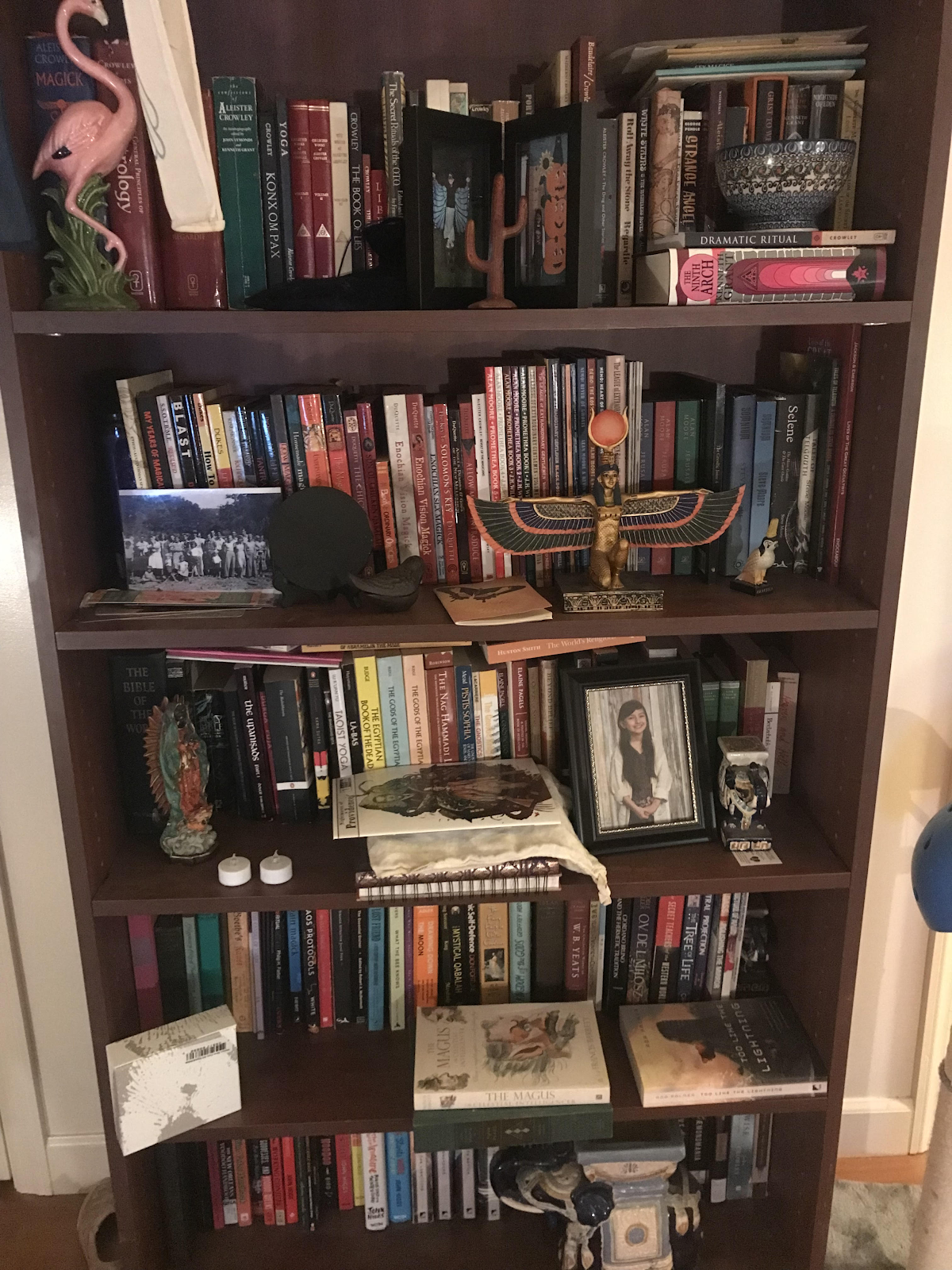
A bookshelf in my home that houses a part of my occult library. 

Update

Decidedly not the book for which I penned an introduction. Although, one could make a perverse argument that Wilson's book is a "Quality Religious Book For Children."

Hello, all. Today I've finished up my introduction to The Walls Came Tumbling Down. I've attempted over the course of my many revisions to play off the ideas that Wilson inserts into the script to continue the dialogue, as it were. Sometimes I might sound a bit dire, but like Wilson and all my beloved "fathers," I am a crank. When it is released next year, I sincerely hope you all enjoy it. Or that it at least doesn't sound like fried drivel. Whichever. 

I'll have my final Sex, Drugs & Magick post up this week. Thankfully, I have a couple days off from work this week. I'm also gearing up for the Natural Law reading group on Tom's blog and will soon have my review of Alan Moore's Illuminations over to him for publication there. 

I'm not sure what I'll be doing here in the coming months. Perhaps not much of anything. Along with Tom's blog, I'm rededicating myself (for real this time) to following Oz's excellent series on Deleuze. I heartily recommend checking out his YouTube channel if you haven't already; it is a real pity that Oz's philosophy isn't one of the bigger ones infecting minds on that website. 

Yours in Ambiguity, 

AC  

TESTAMENT #17 "Blood Brothers (Part I) - The Stolen Blessing"

LINK TO FREE WEB COMIC VERSION OF TESTAMENT #17 (NSFW) Quick reminder that TESTAMENT can get pretty explicit! Original solicitation copy fo...